
How to Change Proxy Settings in Edge
Learn how to set up, change, or turn off a proxy for Microsoft Edge on Windows, Mac, and managed devices.
To change proxy settings in Edge, open the browser’s Settings, search for “proxy,” and select the option to open your computer’s proxy settings. Configure the proxy in your operating system, then return to Edge and test a website. Edge usually relies on the system’s network configuration, so changing the setting there affects other apps as well.
The exact steps vary by operating system. On a work or school device, your organization may manage the settings and prevent you from changing them.

Editor's pick: NordVPN — fast, secure VPN — Strong encryption, a no-logs policy and apps for every device. 30-day money-back guarantee. Get NordVPN →
Proxy-setting paths by operating system
| Operating system | Where to open settings | Proxy setting location | How Edge applies the change | Best for |
|---|---|---|---|---|
| Windows 11 | Edge menu > Settings | System and performance > Open your computer’s proxy settings | Opens Windows Settings | Changing the proxy for Windows |
| Windows 10 | Edge menu > Settings | System > Open your computer’s proxy settings | Opens Windows Settings | Changing the proxy for Windows |
| macOS | Edge menu > Settings | System and performance > Open your computer’s proxy settings | Opens macOS network settings | Changing the proxy for your Mac |
| Edge settings page | Settings search | Search for “proxy” | Directs you to the operating system | Finding the relevant setting |
| Windows proxy page | Windows Settings | Network & internet > Proxy | Configures Windows proxy options | Setting up a Windows proxy |
| Mac network settings | macOS System Settings | Network > active connection > Details > Proxies | Configures proxy options for that connection | Setting up a Mac proxy |
Compiled November 2026; check the provider's site for current details.
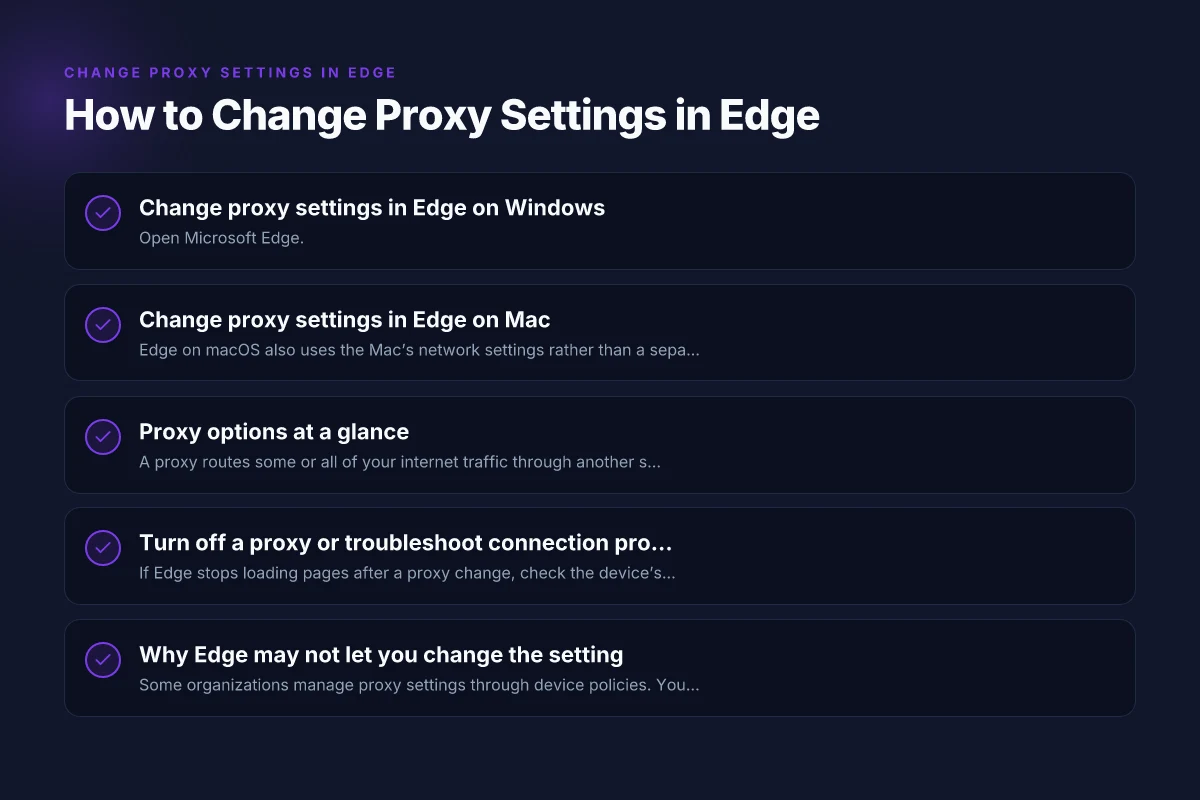
Change proxy settings in Edge on Windows
- Open Microsoft Edge.
- Select the three-dot menu in the upper-right corner, then choose Settings.
- Search Settings for proxy, or go to System and performance and select Open your computer’s proxy settings. The wording or location can vary by Edge version.
- In the Windows Proxy settings, choose the configuration that matches the information you received.
- Save any changes, then return to Edge and load a website to check the connection.
Windows provides two common ways to configure a proxy:
- Automatically detect settings: Windows looks for proxy settings on the network. This is often appropriate for office or school networks that use automatic configuration.
- Use setup script: Enter the URL of a proxy configuration script, sometimes called a PAC file.
- Use a proxy server: Enter a server address and port. You can also set exceptions for addresses that should bypass the proxy.
If you received a script URL, select the setup-script option and enter the full address. If you received a server address and port, enable the manual proxy option and enter both values as provided. Avoid guessing these details: an incorrect address or port can prevent Edge from connecting.
Change proxy settings in Edge on Mac
Edge on macOS also uses the Mac’s network settings rather than a separate browser-only proxy control.
- Open System Settings from the Apple menu.
- Select Network, then choose the active connection, such as Wi-Fi or Ethernet.
- Open Details and select Proxies. The labels may differ slightly depending on your macOS version.
- Choose the proxy type your network administrator or provider specified.
- Enter the required server address, port, and any other requested details, then select OK or Apply.
Return to Edge and test the connection. If your network requires authentication, follow the prompts or instructions from the administrator. Do not enter credentials into an unfamiliar prompt unless you have verified that the network or proxy service is legitimate. NordVPN Edge: How to Use NordVPN with Microsoft Edge
Proxy options at a glance
| Option | What it does | When to use it | Setup information needed | Scope |
|---|---|---|---|---|
| Automatically detect settings | Lets Windows detect proxy settings | On networks that provide automatic configuration | Network support | Windows |
| Use setup script | Applies settings from a configuration script | When an organization provides a script address | Script address | Windows |
| Use a proxy server | Sends traffic through a specified proxy | When you have proxy details from a provider or administrator | Address and port | Windows |
| Bypass proxy for local addresses | Excludes local addresses from the proxy | When local network access should be direct | Bypass preference | Windows |
| Automatic Proxy Configuration | Uses automatic proxy configuration on a Mac | When the network supplies a configuration URL | Configuration URL | macOS |
| Web Proxy (HTTP) | Sets a proxy for HTTP traffic | When the network requires an HTTP proxy | Server address and port | macOS |
| Secure Web Proxy (HTTPS) | Sets a proxy for secure web traffic | When the network requires an HTTPS proxy | Server address and port | macOS |
| SOCKS Proxy | Routes supported traffic through a SOCKS proxy | When the provider specifies SOCKS | Server address and port | macOS |
Compiled November 2026; check the provider's site for current details.
Proxy options at a glance
| Option | What you enter or do | Best suited to |
|---|---|---|
| Automatic detection | Let the device look for proxy settings | Networks configured to provide proxy details automatically |
| Setup script | Enter a configuration script URL | Organizations that supply a PAC file |
| Manual proxy | Enter a server address and port | Networks or services that provide specific connection details |
| No proxy | Disable manual proxy settings | Direct connections or troubleshooting, when permitted |
A proxy routes some or all of your internet traffic through another server. It can be required for a company network, filtering, or a particular service. It is not the same as a VPN, and it does not automatically encrypt all traffic between your device and the internet.
Turn off a proxy or troubleshoot connection problems
If Edge stops loading pages after a proxy change, check the device’s proxy settings first. A mistyped server address, port, or script URL is a common cause. Mac VPN Guide: How to Choose and Use a VPN on Your Mac
Try these steps:
- Confirm that you are connected to the internet and using the correct Wi-Fi or network.
- Check the proxy details against the instructions from your organization or service.
- If you no longer need the proxy, return to your system’s Proxy settings and turn off the relevant manual proxy or setup script. Keep automatic detection enabled if your network requires it.
- Restart Edge and test more than one website.
- If the settings are managed, contact your IT administrator instead of trying to bypass the restriction.
If a proxy is configured but the connection still fails, the proxy server itself may be unavailable or may require authentication. Check with the provider or administrator before changing other network settings.
Why Edge may not let you change the setting
Some organizations manage proxy settings through device policies. You may see that an option is disabled, or a setting may return after you change it. This can happen on a work or school computer, or on a device connected to organization management.
Edge may also display a message such as Managed by your organization. That message does not by itself indicate a problem. It means some browser or device settings are controlled by an administrator. Ask your IT team which proxy configuration to use. IPsec MTU: How to Set It and Avoid Fragmentation
Avoid installing unfamiliar extensions or apps that claim to change Edge’s proxy. Because Edge uses system settings, a browser extension may not be a reliable or appropriate way to configure the device’s network connection.
Choose a troubleshooting step
| Situation | First check | Likely action | Who can change it | Caution |
|---|---|---|---|---|
| Pages will not load after proxy setup | Proxy address and port | Correct the details or turn off the proxy | Device user or administrator | Verify details with the provider |
| Proxy should not be in use | System proxy settings | Disable the active proxy option | Device user or administrator | Managed settings may be locked |
| Setup script is not working | Script address and network access | Confirm the script URL with the network administrator | Network administrator may be needed | Do not use an untrusted script |
| Automatic detection is failing | Network connection and detection option | Check the network’s proxy requirements | Device user or administrator | Detection depends on network support |
| Edge opens system settings instead of showing proxy fields | Windows or macOS settings | Make the change in the operating system | Device user or administrator | Edge uses system proxy settings |
| Proxy controls are unavailable | Management or policy restrictions | Contact the organization’s administrator | Administrator | Do not try to bypass workplace policy |
| Only some apps use the proxy | App-specific proxy behavior | Check the settings for the affected app | Device user or administrator | Proxy use can vary by app |
Compiled November 2026; check the provider's site for current details.
Recommendation
Use the proxy address, port, or setup script supplied by a trusted administrator or provider, and configure it through your device’s network settings. If you are unsure whether a proxy is required, ask your network administrator before turning one on or off. Big IP f5 VPN download: How to Get and Install the Official VPN Client