FortiGate VPN PFS: What It Is and How to Configure It
Learn how FortiGate VPN PFS works, when to enable it, and how to configure matching IPsec settings on both peers.
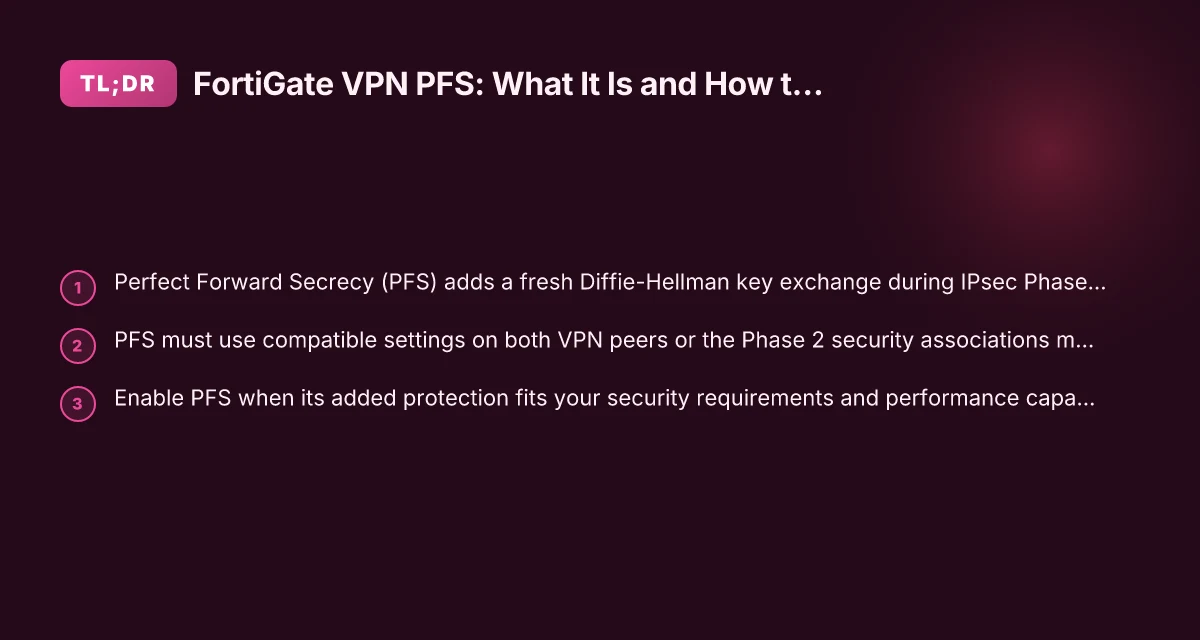
FortiGate VPN PFS means Perfect Forward Secrecy for an IPsec VPN. It uses a new Diffie-Hellman exchange when creating or renewing Phase 2 keys, helping ensure that a later compromise of one key does not expose past VPN traffic protected by other keys. To work, PFS must be configured consistently at both ends of the tunnel.

Editor's pick: NordVPN — fast, secure VPN — Strong encryption, a no-logs policy and apps for every device. 30-day money-back guarantee. Get NordVPN →
Quick comparison of FortiGate VPN PFS choices
| Choice | PFS behavior | Security effect | Compatibility impact |
|---|---|---|---|
| PFS disabled | No fresh DH exchange for Phase 2 | Less key separation | May suit peers that do not support PFS |
| PFS enabled | Performs a fresh DH exchange for Phase 2 | Adds key separation | Both peers must agree on settings |
| Matching DH groups | Uses the same group on both peers | Establishes compatible keys | Required for negotiation |
| Different DH groups | Peers request different groups | No compatible key exchange | Can prevent Phase 2 from coming up |
| PFS with stronger group | Uses a stronger DH group | More robust key agreement | Check peer support |
| PFS with unsupported group | Peer cannot use the requested group | No added protection in practice | Can cause negotiation failure |
Compiled November 2026; check the provider's site for current details.
| VPN | Obfuscation | From / month | Plan | Free plan | Refund | Alipay | UnionPay | Crypto | Website opens in China | Trustpilot | |
|---|---|---|---|---|---|---|---|---|---|---|---|
 ZoogVPN | Turn on manually Shadow | $2.49/mo | 27 months: $59.99 | Yes | 7 days | ✓ | ✓ | ✓ | ✓ | Official site blocked; our special link opens (4.4 s) | 4.2/5 (195 reviews) |
 NordVPN | Turn on manually Obfuscated Servers / NordWhisper | $3.49/mo | 27 months: $94.23 | No | 30 days | ? | ✗ | ✓ | ✓ | ✗ Blocked | 4.2/5 (51,628 reviews) |
 ExpressVPN | ✓ On by default all servers | $3.00/mo | 28 months: $84 | No | 30 days | ✗ | ✗ | ✓ | ✗ | ✗ Blocked | 4.4/5 (29,706 reviews) |
 Surfshark | ✓ On by default Camouflage, with OpenVPN | See site | See site | No | 30 days | ✗ | ✗ | ✗ | ✓ | ✗ Blocked | 4.3/5 (31,823 reviews) |
 Proton VPN | Turn on manually Stealth, free plan too | $2.99/mo | 12 months: $35.88 | Yes | 30 days | ✗ | ✗ | ✗ | ✓ | ✗ Blocked | 2.1/5 (1,040 reviews) |
 Astrill VPN | Turn on manually StealthVPN / OpenWeb | $12.50/mo | 24 months: $300 | No | See site | ✗ | ✗ | ✗ | ✓ | ✗ Blocked | 1.3/5 (110 reviews) |
 Private Internet Access | Turn on manually Shadowsocks, OpenVPN only | $2.03/mo | 40 months: $81.2 | No | 30 days | ✗ | ✗ | ✗ | ✗ | ✗ Blocked | 4.2/5 (11,033 reviews) |
 CyberGhost | Turn on manually selected servers | $2.19/mo | 28 months: $61.32 | No | 45 days | ✗ | ✗ | ✗ | ✓ | ✗ Blocked | 4.0/5 (24,178 reviews) |
 PureVPN | Turn on manually switch to OpenVPN | $1.69/mo | 60 months: $101.55 | No | 31 days | ? | ? | ✗ | ✓ | ✗ Blocked | 4.4/5 (17,994 reviews) |
 AdGuard VPN | ✓ On by default TrustTunnel | $2.99/mo | 24 months: $71.76 | Yes | 30 days | ✓ | ✗ | ✓ | ✓ | Official site blocked; our special link opens (3.7 s) | 4.3/5 (290 reviews) |
 Mullvad | Turn on manually QUIC / Shadowsocks / LWO | $5.61/mo | €5/mo | No | 14 days | ✗ | ✗ | ✗ | ✓ | ✗ Blocked | 3.2/5 (192 reviews) |
 Windscribe | Turn on manually Stealth / WStunnel | $5.75/mo | 12 months: $69 | Yes | See site | ✗ | ✗ | ✗ | ✓ | ✗ Blocked | 4.7/5 (13,355 reviews) |
 StrongVPN | Turn on manually Scramble, OpenVPN TCP | See site | See site | No | 30 days | ✓ | ✗ | ✗ | ✗ | ✗ Blocked | 4.4/5 (2,695 reviews) |
 LightXtreme 闪连 | Not listed | $7.08/mo | 12 months: $84.99 | Yes | 30 days | ✓ | ✓ | ✓ | ✓ | ✓ Yes (3.5 s) | No page |
Prices checked 2026-11-10 on each vendor's pricing page (cheapest long plan, USD). Check the vendor's checkout for the final price.
Obfuscation checked 2026-11-14 on each vendor's site and help center: "on by default" = nothing to set; "turn on manually" = switch protocol or mode in settings; "not listed" = the vendor describes no obfuscation.
Payment methods checked 2026-11-10 on each vendor's payment pages: all 14 take cards and PayPal; ✗ = not listed, ? = the vendor's own pages disagree.
China access: whether the official website opens from mainland China networks (tests the website only, not the VPN connection). Last checked 2026-11-18 01:02 Beijing time.
Trustpilot score and review count checked 2026-11-10.
What PFS does in a FortiGate VPN
An IPsec VPN uses security associations (SAs) to define how traffic is protected. In a typical FortiGate IPsec VPN, Phase 1 establishes the IKE relationship between peers, while Phase 2 creates the SAs that protect the actual traffic.
Without PFS, a Phase 2 rekey can derive fresh traffic keys from existing keying material. With PFS enabled, the peers perform an additional Diffie-Hellman exchange to generate new shared secret material for the rekey. This provides an extra layer of key separation.
PFS is designed to limit the impact of a future key compromise. If an attacker later obtains a particular VPN key, PFS can make it harder to use that key to decrypt traffic protected by earlier, separate keys. It does not protect against compromised endpoints, weak credentials, traffic-analysis exposure, or every possible implementation flaw.
Phase 1, Phase 2, and PFS settings
PFS is generally configured as a Phase 2 setting in FortiGate IPsec VPNs. The selected Diffie-Hellman group determines the parameters used for the additional exchange. FortiClient VPN 7.2 Download: Safe Sources, Installation, and Setup
The two peers must agree on the Phase 2 proposal and PFS settings. If one side requires PFS and the other does not, or if they use incompatible Diffie-Hellman groups, Phase 2 negotiation can fail. A tunnel may show Phase 1 as up while carrying no traffic because the Phase 2 SA has not been established.
| Setting | What it controls | What to check |
|---|---|---|
| Phase 1 proposal | IKE encryption and integrity | Must match the peer’s IKE proposal |
| Phase 2 proposal | Protection for VPN traffic | Encryption and authentication algorithms must be compatible |
| PFS | Additional key exchange during Phase 2 creation or rekey | Enable or disable consistently on both peers |
| Diffie-Hellman group | Parameters for the PFS exchange | Choose a group supported by both peers |
| Key lifetime | When an SA is renewed | Confirm rekey behavior and timing are compatible |
The exact labels and available groups can vary by FortiOS release and VPN configuration. Check the Fortinet documentation for your version and the capabilities of the remote device.
FortiGate IPsec VPN settings by phase
| Setting | VPN phase | What it controls | Peer requirement | If mismatched |
|---|---|---|---|---|
| Encryption | Phase 1 | IKE control-channel protection | Compatible proposal | Phase 1 negotiation may fail |
| Authentication | Phase 1 | Peer authentication method | Compatible method and credentials | Phase 1 negotiation may fail |
| DH group | Phase 1 | Key exchange for IKE | Compatible group | Phase 1 negotiation may fail |
| Encryption | Phase 2 | IPsec data protection | Compatible proposal | Phase 2 negotiation may fail |
| Authentication | Phase 2 | IPsec integrity protection | Compatible proposal | Phase 2 negotiation may fail |
| PFS | Phase 2 | Requests fresh key exchange | Same PFS setting | Phase 2 negotiation may fail |
| PFS DH group | Phase 2 | Group for the fresh exchange | Same supported group | Phase 2 negotiation may fail |
Compiled November 2026; check the provider's site for current details. Catvpn Review: What It Is, How It Works, and What to Check
How to configure PFS
Before changing a live tunnel, record its current settings and confirm that you can access both VPN peers. If the tunnel is business-critical, schedule the change for a maintenance window and prepare a rollback plan.
In the FortiGate GUI, the usual workflow is:
- Open VPN > IPsec Tunnels.
- Edit the relevant tunnel.
- Locate the Phase 2 or Phase 2 Selectors settings.
- Enable PFS, if the option is available for that configuration.
- Select a supported Diffie-Hellman group.
- Save the settings and apply the matching configuration on the remote peer.
For a FortiGate-to-FortiGate tunnel, both devices need compatible Phase 2 proposals, PFS settings, and DH groups. For a third-party peer, use its vendor’s configuration guide to map the settings correctly. Names and group numbering can differ between products.
FortiOS also supports configuring IPsec settings through the CLI. Because syntax and available options vary by release, use the command reference for your FortiOS version rather than copying an unverified command. After making changes, check that the tunnel negotiates successfully and that the intended traffic passes through it. Best Free VPN Extensions for Microsoft Edge: What to Know
Choosing a PFS group
A stronger or more computationally demanding DH group can increase the cost of key exchange. The best choice is not simply the group with the largest number: it must be supported by both peers, allowed by your security policy, and suitable for the devices’ performance.
Consider these points when selecting a group:
- Follow your organization’s cryptographic standards and current security guidance.
- Use a group supported by both VPN devices and their software versions.
- Avoid weakening a policy solely to make an outdated peer connect. Plan to update or replace it where possible.
- Test rekeying as well as initial tunnel establishment, since PFS is relevant when Phase 2 SAs are renewed.
- Check device CPU usage and tunnel stability under expected traffic conditions.
Do not assume that enabling PFS automatically strengthens every part of the VPN. Review the complete IKE and IPsec configuration, including encryption algorithms, integrity protection, authentication, certificates or pre-shared keys, and software updates.
Troubleshooting PFS negotiation Free VPN Extension for Microsoft Edge Browser: What to Choose
| Symptom | Likely issue | What to compare | Next step |
|---|---|---|---|
| Phase 1 is down | IKE proposal or credentials mismatch | Phase 1 settings on both peers | Align proposals and authentication |
| Phase 1 is up, Phase 2 is down | Phase 2 proposal mismatch | Encryption and authentication | Align Phase 2 proposals |
| Phase 2 fails with PFS enabled | PFS setting differs | PFS enabled or disabled on each peer | Make the settings match |
| Phase 2 fails after enabling PFS | DH groups differ | Phase 2 PFS group on each peer | Select a mutually supported group |
| Tunnel works only with PFS off | Peer may not support the selected PFS settings | Peer capabilities and configuration | Confirm support or use a compatible group |
| Tunnel drops during rekey | Rekey negotiation settings may differ | PFS, group, and Phase 2 proposals | Align settings and test rekey |
| Configuration appears correct | Negotiation details are unclear | FortiGate VPN logs and peer logs | Review logs for proposal or group errors |
Compiled November 2026; check the provider's site for current details.
Troubleshooting FortiGate VPN PFS
If the tunnel stops passing traffic after enabling PFS, start by comparing the Phase 2 settings on both ends. Confirm that PFS is enabled on both peers, that the DH group matches, and that the encryption and integrity proposals are compatible.
Then check the following:
- Phase 1 is up, but Phase 2 is down: Review Phase 2 selectors, proposals, PFS, and DH group settings.
- The tunnel works initially but fails during rekeying: Check key lifetimes, rekey timing, and whether both devices support the chosen group.
- Only some networks can communicate: Verify that Phase 2 selectors and routing match the intended traffic.
- The GUI settings appear correct: Review VPN event logs and FortiGate diagnostics for negotiation errors, and compare them with logs from the remote peer.
Apply changes to both sides in a coordinated way. If troubleshooting requires a temporary PFS change, treat it as a security-impacting exception, document it, and restore the approved configuration as soon as possible. VPN 360 for Windows 11: How to Install, Use, and Check It Safely
Recommendation
Enable FortiGate VPN PFS when your security policy calls for stronger protection of past traffic against later key compromise, and choose a DH group both peers support. Match the settings on both ends, verify Phase 2 establishment and rekeying, and test the tunnel before relying on the change in production.