Is Cato a VPN? What Cato SASE Actually Does
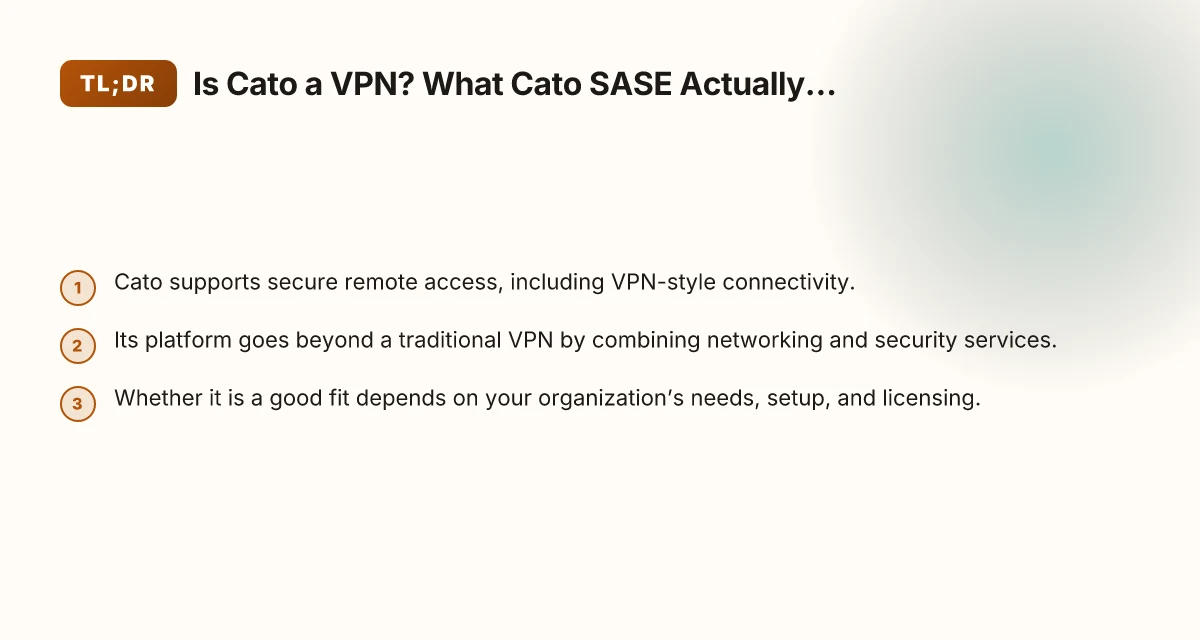
Cato is not simply a VPN. It combines remote access with cloud-delivered security and networking in a SASE platform.
Cato can provide VPN-style access, but it is not just a VPN service. Cato Networks offers a cloud-delivered Secure Access Service Edge (SASE) platform that brings together remote access, network connectivity, and security controls. For businesses, this can replace or supplement separate VPN, firewall, and networking products. The distinction matters: a VPN describes one way to create a protected connection, while Cato is a broader platform for managing access and traffic.

Editor's pick: NordVPN — fast, secure VPN — Strong encryption, a no-logs policy and apps for every device. 30-day money-back guarantee. Get NordVPN →
Cato SASE and a traditional VPN compared
| Comparison point | Cato SASE | Traditional VPN |
|---|---|---|
| Core approach | Cloud-delivered SASE platform | Encrypted tunnel |
| Remote access | Connects users to Cato’s network | Connects users to a VPN gateway |
| Security scope | Network access and security services | Primarily secures the connection |
| Traffic routing | Through Cato’s global network | Through the selected VPN gateway |
| Access control | Based on user and policy | Often based on network access |
| Branch connectivity | Supported through Cato | May require separate VPN setup |
| Best fit | Organizations seeking converged networking and security | Organizations needing secure remote connections |
Compiled November 2026; check the provider's site for current details.
| VPN | Obfuscation | From / month | Plan | Free plan | Refund | Alipay | UnionPay | Crypto | Website opens in China | Trustpilot | |
|---|---|---|---|---|---|---|---|---|---|---|---|
 ZoogVPN | Turn on manually Shadow | $2.49/mo | 27 months: $59.99 | Yes | 7 days | ✓ | ✓ | ✓ | ✓ | Official site blocked; our special link opens (4.4 s) | 4.2/5 (195 reviews) |
 NordVPN | Turn on manually Obfuscated Servers / NordWhisper | $3.49/mo | 27 months: $94.23 | No | 30 days | ? | ✗ | ✓ | ✓ | ✗ Blocked | 4.2/5 (51,628 reviews) |
 ExpressVPN | ✓ On by default all servers | $3.00/mo | 28 months: $84 | No | 30 days | ✗ | ✗ | ✓ | ✗ | ✗ Blocked | 4.4/5 (29,706 reviews) |
 Surfshark | ✓ On by default Camouflage, with OpenVPN | See site | See site | No | 30 days | ✗ | ✗ | ✗ | ✓ | ✗ Blocked | 4.3/5 (31,823 reviews) |
 Proton VPN | Turn on manually Stealth, free plan too | $2.99/mo | 12 months: $35.88 | Yes | 30 days | ✗ | ✗ | ✗ | ✓ | ✗ Blocked | 2.1/5 (1,040 reviews) |
 Astrill VPN | Turn on manually StealthVPN / OpenWeb | $12.50/mo | 24 months: $300 | No | See site | ✗ | ✗ | ✗ | ✓ | ✗ Blocked | 1.3/5 (110 reviews) |
 Private Internet Access | Turn on manually Shadowsocks, OpenVPN only | $2.03/mo | 40 months: $81.2 | No | 30 days | ✗ | ✗ | ✗ | ✗ | ✗ Blocked | 4.2/5 (11,033 reviews) |
 CyberGhost | Turn on manually selected servers | $2.19/mo | 28 months: $61.32 | No | 45 days | ✗ | ✗ | ✗ | ✓ | ✗ Blocked | 4.0/5 (24,178 reviews) |
 PureVPN | Turn on manually switch to OpenVPN | $1.69/mo | 60 months: $101.55 | No | 31 days | ? | ? | ✗ | ✓ | ✗ Blocked | 4.4/5 (17,994 reviews) |
 AdGuard VPN | ✓ On by default TrustTunnel | $2.99/mo | 24 months: $71.76 | Yes | 30 days | ✓ | ✗ | ✓ | ✓ | Official site blocked; our special link opens (3.7 s) | 4.3/5 (290 reviews) |
 Mullvad | Turn on manually QUIC / Shadowsocks / LWO | $5.61/mo | €5/mo | No | 14 days | ✗ | ✗ | ✗ | ✓ | ✗ Blocked | 3.2/5 (192 reviews) |
 Windscribe | Turn on manually Stealth / WStunnel | $5.75/mo | 12 months: $69 | Yes | See site | ✗ | ✗ | ✗ | ✓ | ✗ Blocked | 4.7/5 (13,355 reviews) |
 StrongVPN | Turn on manually Scramble, OpenVPN TCP | See site | See site | No | 30 days | ✓ | ✗ | ✗ | ✗ | ✗ Blocked | 4.4/5 (2,695 reviews) |
 LightXtreme 闪连 | Not listed | $7.08/mo | 12 months: $84.99 | Yes | 30 days | ✓ | ✓ | ✓ | ✓ | ✓ Yes (3.5 s) | No page |
Prices checked 2026-11-10 on each vendor's pricing page (cheapest long plan, USD). Check the vendor's checkout for the final price.
Obfuscation checked 2026-11-14 on each vendor's site and help center: "on by default" = nothing to set; "turn on manually" = switch protocol or mode in settings; "not listed" = the vendor describes no obfuscation.
Payment methods checked 2026-11-10 on each vendor's payment pages: all 14 take cards and PayPal; ✗ = not listed, ? = the vendor's own pages disagree.
China access: whether the official website opens from mainland China networks (tests the website only, not the VPN connection). Last checked 2026-11-18 01:02 Beijing time.
Trustpilot score and review count checked 2026-11-10.
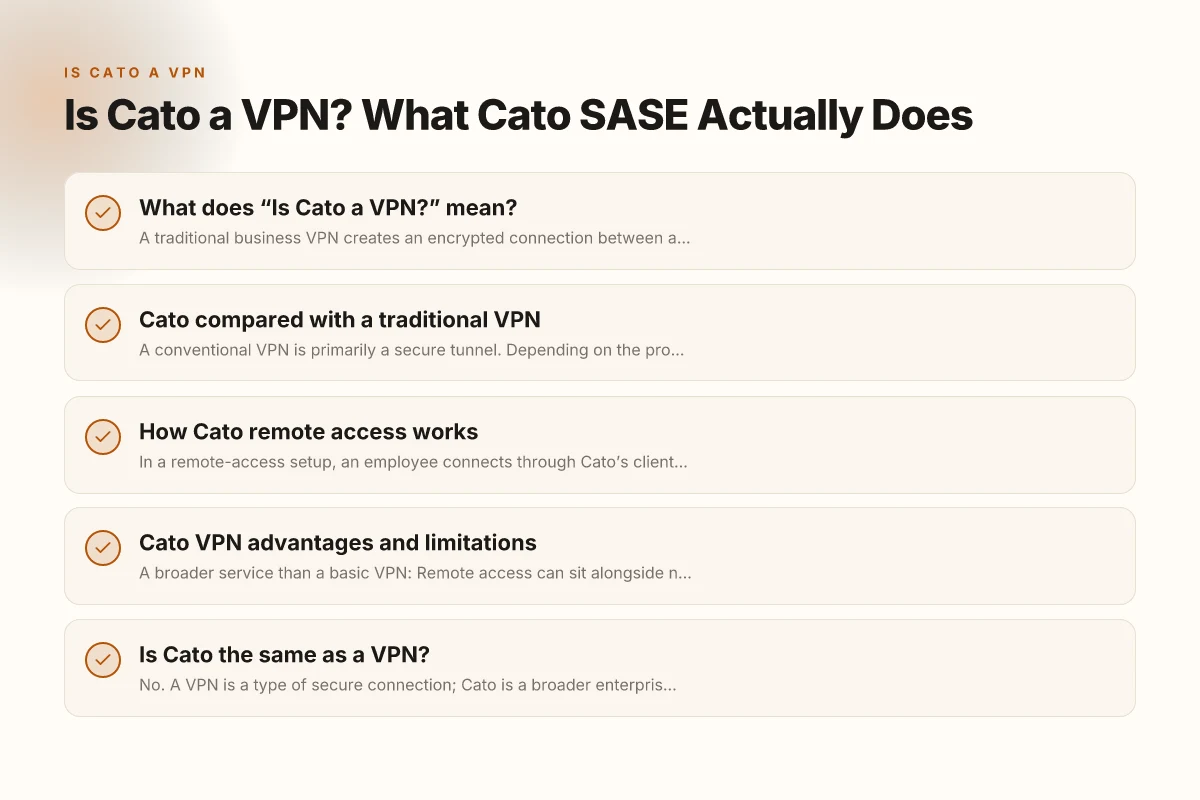
What does “Is Cato a VPN?” mean?
A traditional business VPN creates an encrypted connection between a user’s device and a company network. This lets employees reach internal applications and resources from outside the office. Cato offers secure remote access that can serve this purpose, so employees may use it instead of a conventional VPN solution.
But calling Cato only a VPN leaves out much of what it does. Cato’s SASE platform is designed to connect users, offices, cloud environments, and data centers through a global cloud service. It can apply security policies to that traffic as it moves between locations.
In short, Cato can provide VPN-like access, but the product is better described as a cloud networking and security platform with remote access capabilities.
Cato compared with a traditional VPN
A conventional VPN is primarily a secure tunnel. Depending on the product, it may also include basic access controls, but organizations often need other tools for firewall protection, web filtering, threat detection, and managing traffic between branch offices. Nord VPN in China: Does It Work and How to Prepare
Cato brings several of these functions into one service. Exact capabilities depend on the package, configuration, and current product offering, so organizations should confirm details with Cato or a qualified reseller.
| Area | Traditional business VPN | Cato SASE platform |
|---|---|---|
| Remote user access | Creates an encrypted connection to company resources | Provides secure remote access as part of a broader service |
| Branch connectivity | May require separate VPN appliances or services | Can connect offices through Cato’s cloud network |
| Security | Often relies on separate security products | Can combine access with cloud-delivered security controls |
| Management | May involve multiple tools and consoles | Aims to centralize networking and security management |
| Scope | Mainly secure connectivity | Connectivity, access, and security services |
This does not mean every Cato deployment automatically replaces every existing product. The organization still needs to choose appropriate policies, configure access, and confirm that the service supports its applications and compliance requirements.
How Cato remote access works
| Stage | What happens | Cato’s role | User experience |
|---|---|---|---|
| Sign-in | User authenticates | Applies access policies | Sign in with approved credentials |
| Connection | Client establishes a connection | Connects user to Cato’s network | Secure remote connection |
| Routing | Traffic is sent for access | Routes traffic through its network | Access to permitted resources |
| Inspection | Traffic is evaluated | Applies configured security controls | Policies operate in the background |
| Resource access | User requests an application or service | Enforces the organization’s rules | Access depends on permissions |
| Ongoing use | Connection remains active | Continues routing and policy enforcement | Work remotely with managed access |
Compiled November 2026; check the provider's site for current details. Free Clash: How to Play Clash Games for Free
How Cato remote access works
In a remote-access setup, an employee connects through Cato’s client or another supported access method. The service checks the connection according to the organization’s configuration and provides access to approved resources. Traffic can then be handled through Cato’s cloud infrastructure and applicable security policies.
The practical experience may resemble connecting to a VPN: the user signs in and gains access to work resources. Behind the scenes, however, the organization may be using a wider set of Cato networking and security capabilities.
A Cato deployment can also connect offices and cloud resources, not just individual remote workers. This broader design is one reason Cato is associated with SASE rather than being categorized solely as a VPN provider.
Cato VPN advantages and limitations
Potential advantages
- A broader service than a basic VPN: Remote access can sit alongside networking and security functions.
- Centralized management: Teams may manage users, sites, and policies through a common platform rather than separate products.
- Support for distributed work: The platform is intended to connect users and locations beyond a single office network.
- Reduced reliance on local hardware: Because services are cloud-delivered, some organizations may be able to simplify branch network equipment.
These advantages depend on the organization’s current architecture and how the service is deployed. Moving to a consolidated platform may simplify operations, but it is not automatically cheaper or easier in every environment. Does Microsoft Edge Have a VPN? What Edge Secure Network Does
Potential limitations
- More functionality may mean more complexity: A SASE platform requires careful planning, policy design, and administration.
- Cost depends on the deployment: Pricing can vary with users, sites, features, and contract terms. Compare the full cost with the tools it may replace.
- Not every use case is identical: Some applications, legacy systems, or regulatory requirements may need specific testing or configuration.
- It is not a consumer VPN: Cato is aimed at business networking and security, rather than personal privacy browsing or changing a consumer’s apparent location.
A VPN connection also does not, by itself, make a device secure. Endpoint protection, identity controls, updates, and well-designed access rules remain important.
Choosing between Cato and a traditional VPN
| Decision factor | Cato may suit you when… | Traditional VPN may suit you when… |
|---|---|---|
| Main need | You want SASE capabilities | You need an encrypted remote connection |
| Security approach | You want networking and security together | A VPN connection is sufficient |
| Network design | You want access through Cato’s network | You use a VPN gateway |
| Access requirements | You need policy-based access | Basic remote network access meets your needs |
| Deployment scope | You are evaluating a broader platform | You are addressing a narrower VPN use case |
| Key distinction | Cato is not simply a traditional VPN | A VPN is a connection method, not a full SASE platform |
Compiled November 2026; check the provider's site for current details.
Is Cato the same as a VPN?
No. A VPN is a type of secure connection; Cato is a broader enterprise service that can include VPN-like remote access. The terms describe different levels of technology. Proton VPN Extension for Edge: How to Install and Use It
It may be helpful to think of a VPN as one component in a company’s connectivity setup. Cato aims to bring that component together with other networking and security services. For a small business that only needs a simple encrypted connection to a few internal systems, a traditional VPN might be sufficient. For an organization managing many users, offices, cloud services, and security policies, a SASE platform may be worth evaluating.
Before making a decision, compare the actual requirements rather than the product labels. Consider:
- Which users, offices, and applications need access?
- Do you need site-to-site connectivity as well as remote-user access?
- Which security features are included in the proposed plan?
- How will the service work with identity systems and endpoint tools?
- What are the implementation, support, and ongoing costs?
- Can you test performance and application compatibility before rollout?
Recommendation
Cato is a good option to evaluate if your organization wants remote access as part of a wider cloud networking and security platform. It is not simply a VPN, though it can perform VPN-like functions. If all you need is a straightforward secure tunnel, compare Cato with simpler VPN products. If you want to consolidate remote access, site connectivity, and security management, assess Cato’s specific features, costs, and fit in a pilot before committing.