
Windows VPN: How It Works, How to Set It Up, and What to Choose
Learn what Windows VPN settings do, how to connect, and how to choose a trustworthy VPN app or service.
A Windows VPN can help protect your internet traffic on untrusted networks or connect you to a work or school network. Windows includes settings for adding and managing VPN connections, but those settings are not themselves a VPN service. To get connected, you typically need a provider, an employer, or another network administrator to give you the connection details, or you can use that provider’s Windows app.

Editor's pick: NordVPN — fast, secure VPN — Strong encryption, a no-logs policy and apps for every device. 30-day money-back guarantee. Get NordVPN →
Built-in Windows VPN and VPN apps compared
| Option | What it is | Server access | Setup | Best suited for |
|---|---|---|---|---|
| Windows built-in VPN | A VPN connection manager | Requires a VPN service or work server | Enter connection details | Connecting to a known VPN |
| VPN provider app | Software from a VPN service | Usually provided by the service | Install, sign in, connect | Personal VPN use |
| Work VPN profile | Organization-managed connection | Employer or school network | Use supplied settings | Accessing work resources |
| Manual VPN profile | Connection configured in Windows | Requires server details | Add a VPN connection | Users with configuration details |
| VPN protocol | Rules for the connection | Depends on the VPN service | Select where available | Matching service requirements |
| VPN server | Remote endpoint for a connection | Depends on provider or organization | Choose in an app or profile | Selecting a location |
| VPN account | Provider login or access credentials | Depends on provider | Sign in to the app | Using a commercial VPN |
Compiled November 2026; check the provider's site for current details.
| VPN | Obfuscation | From / month | Plan | Free plan | Refund | Alipay | UnionPay | Crypto | Website opens in China | Trustpilot | |
|---|---|---|---|---|---|---|---|---|---|---|---|
 Proton VPN | Turn on manually Stealth, free plan too | $2.99/mo | 12 months: $35.88 | Yes | 30 days | ✗ | ✗ | ✗ | ✓ | ✗ Blocked | 2.1/5 (1,040 reviews) |
 NordVPN | Turn on manually Obfuscated Servers / NordWhisper | $3.49/mo | 27 months: $94.23 | No | 30 days | ? | ✗ | ✓ | ✓ | ✗ Blocked | 4.2/5 (51,628 reviews) |
 ZoogVPN | Turn on manually Shadow | $2.49/mo | 27 months: $59.99 | Yes | 7 days | ✓ | ✓ | ✓ | ✓ | Official site blocked; our special link opens (4.4 s) | 4.2/5 (195 reviews) |
 ExpressVPN | ✓ On by default all servers | $3.00/mo | 28 months: $84 | No | 30 days | ✗ | ✗ | ✓ | ✗ | ✗ Blocked | 4.4/5 (29,706 reviews) |
 Surfshark | ✓ On by default Camouflage, with OpenVPN | See site | See site | No | 30 days | ✗ | ✗ | ✗ | ✓ | ✗ Blocked | 4.3/5 (31,823 reviews) |
 Astrill VPN | Turn on manually StealthVPN / OpenWeb | $12.50/mo | 24 months: $300 | No | See site | ✗ | ✗ | ✗ | ✓ | ✗ Blocked | 1.3/5 (110 reviews) |
 Private Internet Access | Turn on manually Shadowsocks, OpenVPN only | $2.03/mo | 40 months: $81.2 | No | 30 days | ✗ | ✗ | ✗ | ✗ | ✗ Blocked | 4.2/5 (11,033 reviews) |
 CyberGhost | Turn on manually selected servers | $2.19/mo | 28 months: $61.32 | No | 45 days | ✗ | ✗ | ✗ | ✓ | ✗ Blocked | 4.0/5 (24,178 reviews) |
 PureVPN | Turn on manually switch to OpenVPN | $1.69/mo | 60 months: $101.55 | No | 31 days | ? | ? | ✗ | ✓ | ✗ Blocked | 4.4/5 (17,994 reviews) |
 AdGuard VPN | ✓ On by default TrustTunnel | $2.99/mo | 24 months: $71.76 | Yes | 30 days | ✓ | ✗ | ✓ | ✓ | Official site blocked; our special link opens (3.7 s) | 4.3/5 (290 reviews) |
 Mullvad | Turn on manually QUIC / Shadowsocks / LWO | $5.61/mo | €5/mo | No | 14 days | ✗ | ✗ | ✗ | ✓ | ✗ Blocked | 3.2/5 (192 reviews) |
 Windscribe | Turn on manually Stealth / WStunnel | $5.75/mo | 12 months: $69 | Yes | See site | ✗ | ✗ | ✗ | ✓ | ✗ Blocked | 4.7/5 (13,355 reviews) |
 StrongVPN | Turn on manually Scramble, OpenVPN TCP | See site | See site | No | 30 days | ✓ | ✗ | ✗ | ✗ | ✗ Blocked | 4.4/5 (2,695 reviews) |
 LightXtreme 闪连 | Not listed | $7.08/mo | 12 months: $84.99 | Yes | 30 days | ✓ | ✓ | ✓ | ✓ | ✓ Yes (3.5 s) | No page |
Prices checked 2026-11-10 on each vendor's pricing page (cheapest long plan, USD). Check the vendor's checkout for the final price.
Obfuscation checked 2026-11-14 on each vendor's site and help center: "on by default" = nothing to set; "turn on manually" = switch protocol or mode in settings; "not listed" = the vendor describes no obfuscation.
Payment methods checked 2026-11-10 on each vendor's payment pages: all 14 take cards and PayPal; ✗ = not listed, ? = the vendor's own pages disagree.
China access: whether the official website opens from mainland China networks (tests the website only, not the VPN connection). Last checked 2026-11-18 01:02 Beijing time.
Trustpilot score and review count checked 2026-11-10.
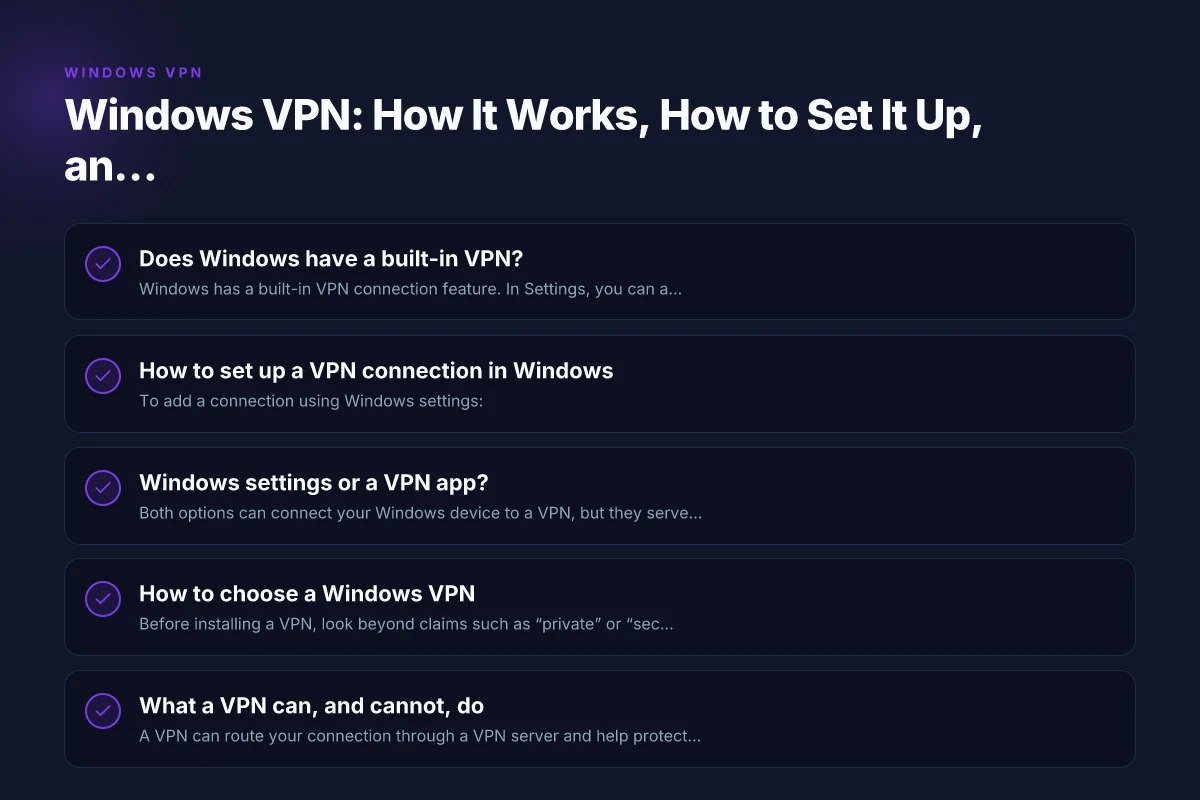
Does Windows have a built-in VPN?
Windows has a built-in VPN connection feature. In Settings, you can add a connection and enter information such as the server name, VPN type, and sign-in details. Those details must come from a VPN provider or network administrator.
This distinction matters: Windows supplies the connection controls, but it does not automatically provide a personal VPN subscription, VPN server, or service that routes your traffic through another location. If you want a commercial VPN, you need to choose a provider and follow its setup instructions.
A VPN can encrypt traffic between your device and the VPN server, depending on the service and connection settings. It does not make you completely anonymous or guarantee that every part of your online activity is private. Websites, apps, and the VPN provider may still collect information.
How to set up a VPN connection in Windows
To add a connection using Windows settings: Free VPN for Microsoft Edge: What You Can Use and How to Choose
- Open Settings.
- Select Network & internet, then VPN.
- Choose Add VPN or Add a VPN connection.
- Select the VPN provider option shown in Windows.
- Enter the connection details supplied by your VPN provider or administrator.
- Save the connection, select it from the VPN list, and choose Connect.
The exact fields and available connection types may vary depending on your Windows version and provider. If you are setting up a work VPN, ask your organization’s IT team for the correct server address, sign-in method, and any required configuration.
Use a VPN provider’s app instead
Many commercial VPN services offer a Windows app. You install the app, sign in, and choose a server or location from its interface. This can be easier than manually entering connection details, and the app may provide provider-specific settings.
For example, Proton VPN offers a Windows app that it describes as open source and designed for ease of use. NordVPN also offers a Windows download. Check each provider’s current plan, features, and privacy information before signing up.
Windows VPN setup routes compared Edge Secure Network VPN Review: Is Microsoft Edge’s VPN Worth Using?
| Route | What you need | Where setup happens | Connection control | Typical use |
|---|---|---|---|---|
| Windows Settings | Server and sign-in details | Windows Settings | Windows connection controls | Work or supplied VPN |
| Provider app | VPN provider account | Provider’s app | App controls and settings | Personal VPN service |
| Work-provided profile | Organization instructions | Windows or managed setup | Organization settings | Work network access |
| Manual configuration | Server address and protocol details | Windows VPN settings | Windows profile options | Custom connection |
| App-based configuration | Provider account and app | Install the provider app | Provider app options | Easy server switching |
| Sign-in credentials | Username and password, if required | During setup or connection | Depends on the service | Authenticated access |
Compiled November 2026; check the provider's site for current details.
Windows settings or a VPN app?
Both options can connect your Windows device to a VPN, but they serve somewhat different needs.
| Option | Best suited to | What you need |
|---|---|---|
| Windows VPN settings | Work, school, or a provider that gives manual configuration details | Server and sign-in information from the administrator or provider |
| Provider’s Windows app | Personal use with a commercial VPN service | The provider’s app and an account or plan, as required |
| Free VPN app or service | Users looking for a no-cost option | Careful review of its limits, privacy practices, and business model |
A manual Windows connection can be useful when an organization supplies a specific setup. A provider app may be more convenient for personal use, especially if you want an interface for choosing servers or managing service-specific options. Neither option should be judged by convenience alone: consider how the service handles data and what protections it actually offers.
How to choose a Windows VPN
Before installing a VPN, look beyond claims such as “private” or “secure.” Review the provider’s privacy policy and learn what information it collects, how it uses that information, and whether it explains its data-retention practices. Get VPN IPsec Tunnel Summary: Check Tunnel Status, Counters, and Troubleshooting Details
Consider these points:
- Trust and transparency: Look for clear ownership, policies, and explanations of how the service works.
- Security features: Check which protections are available and whether they meet your needs.
- Ease of use: Make sure the Windows app or manual setup process is clear.
- Service limits: Free options may have restrictions. Read the terms rather than assuming a free service provides the same experience as a paid one.
- Your purpose: A workplace VPN, a personal privacy tool, and a connection to a specific network are different use cases.
There is no universal answer to whether a VPN is “100% free.” Some services offer free options, but availability, limits, and terms differ. Check the provider’s current details before installing or relying on one.
What a Windows VPN can and cannot do
| Need or expectation | Can a VPN help? | What to check | Limitation |
|---|---|---|---|
| Encrypt traffic to the VPN server | Yes | Service and connection settings | Does not protect every part of a device |
| Connect to a work network | Yes, with access details | Employer instructions | Requires an authorized server and account |
| Change the apparent network location | Often | Available server locations | Websites may use other location signals |
| Make public Wi-Fi safer | Yes, for traffic through the VPN | VPN connection is active | Does not prevent all online risks |
| Hide activity from an internet provider | Often, for VPN-routed traffic | Provider privacy practices | The VPN provider may see connection data |
| Prevent malware | No | Use security software and safe practices | A VPN is not antivirus protection |
| Guarantee anonymity | No | Review provider logging and account policies | Websites can identify users in other ways |
| Protect traffic when disconnected | Not necessarily | Check the app’s protection settings | Coverage depends on configuration |
| Bypass every website restriction | No | Check site and service rules | VPN access is not guaranteed |
Compiled November 2026; check the provider's site for current details. FortiClient VPN Windows 11: Install, Connect, and Troubleshoot
What a VPN can, and cannot, do
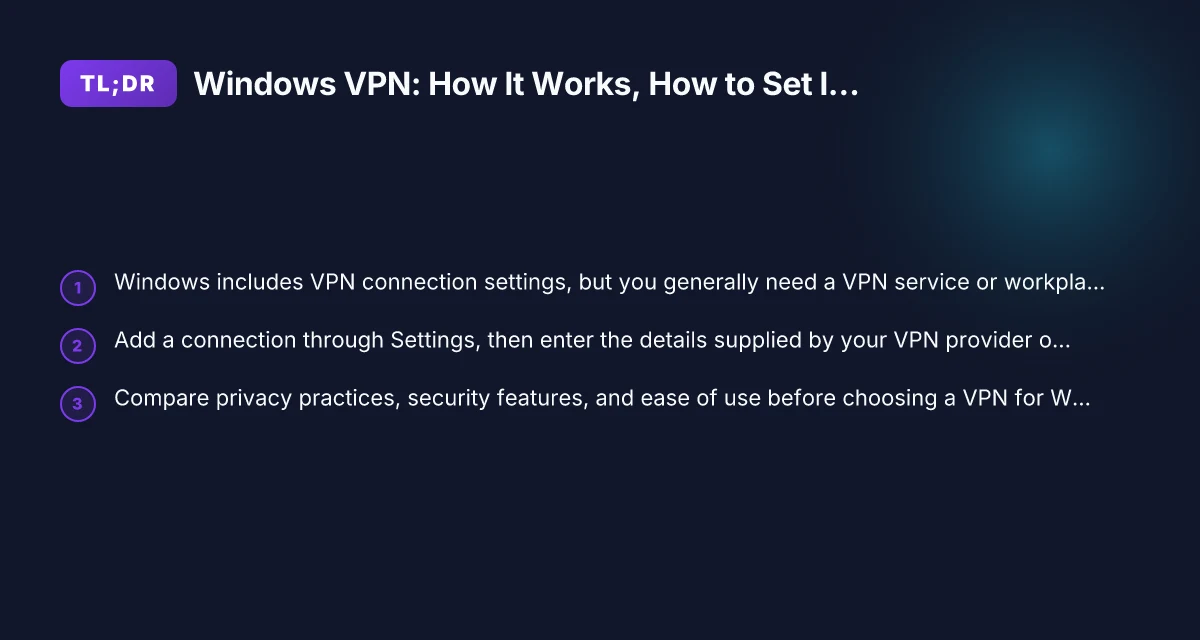
A VPN can route your connection through a VPN server and help protect traffic on the path between your device and that server. This can be useful on public Wi-Fi or when an organization requires a secure connection to its internal network.
However, a VPN does not prevent all tracking, protect you from every kind of malware, or make unsafe websites safe. It also shifts some trust from your internet provider to the VPN provider. Choose a provider carefully, keep Windows and your apps updated, and use other security measures such as strong, unique passwords.
A VPN also does not mean that no one can ever observe activity. What can be seen depends on the network, service, websites, and other circumstances. A VPN changes how your traffic is routed. It is not a guarantee of anonymity.
Recommendation
If your employer or school provided VPN details, use those instructions and add the connection through Settings > Network & internet > VPN. For personal use, compare reputable providers and consider their Windows apps if you want a simpler setup. In either case, remember that Windows provides connection settings, not a VPN service on its own, and review the provider’s privacy practices before connecting. VPN for Edge: How to Choose a Safe Option