What Is an.ovpn File? How to Use and Protect It
Learn what an.ovpn file contains, how to import it into a VPN app, and how to handle it securely.
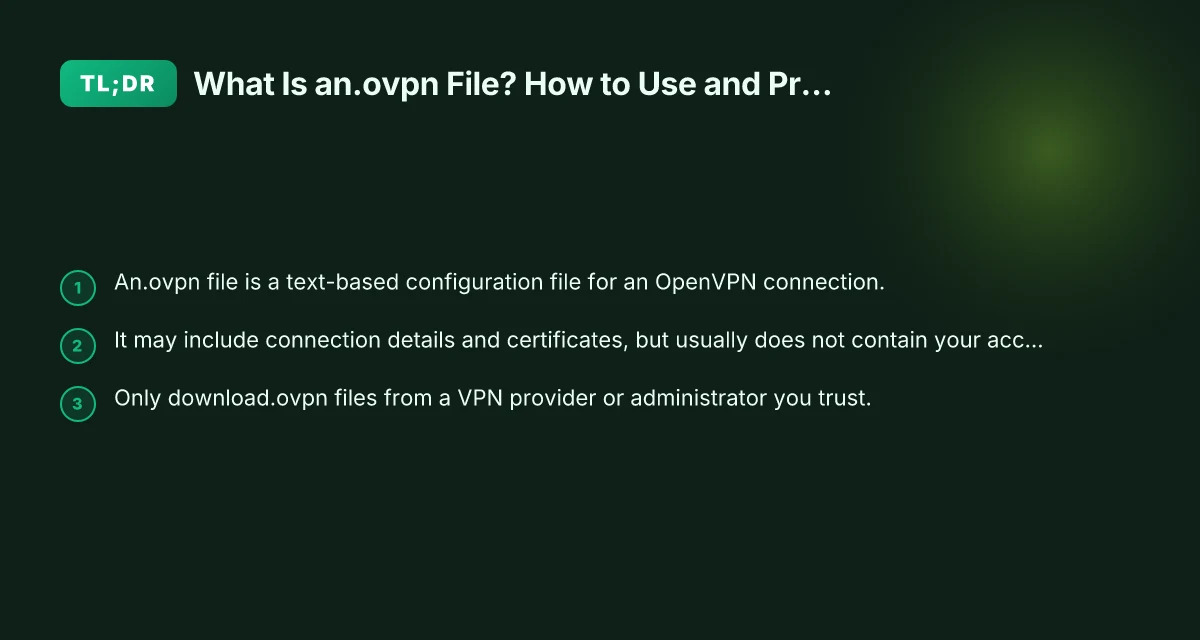
An.ovpn file is a configuration file used by OpenVPN software to connect to a virtual private network (VPN). It tells the VPN client which server to contact and how to establish the encrypted connection. To use one, install a compatible OpenVPN app, import the file, and connect, following any extra sign-in steps required by your provider.
The file is not usually a VPN app itself, and it does not automatically provide VPN service. You need a working VPN account or a configuration supplied by your organization. Because an.ovpn file may contain certificates or other sensitive connection information, use a trusted source and store it carefully.
| VPN | Obfuscation | From / month | Plan | Free plan | Refund | Alipay | UnionPay | Crypto | Website opens in China | Trustpilot | |
|---|---|---|---|---|---|---|---|---|---|---|---|
 ZoogVPN | Turn on manually Shadow | $2.49/mo | 27 months: $59.99 | Yes | 7 days | ✓ | ✓ | ✓ | ✓ | Official site blocked; our special link opens (4.4 s) | 4.2/5 (195 reviews) |
 NordVPN | Turn on manually Obfuscated Servers / NordWhisper | $3.49/mo | 27 months: $94.23 | No | 30 days | ? | ✗ | ✓ | ✓ | ✗ Blocked | 4.2/5 (51,628 reviews) |
 ExpressVPN | ✓ On by default all servers | $3.00/mo | 28 months: $84 | No | 30 days | ✗ | ✗ | ✓ | ✗ | ✗ Blocked | 4.4/5 (29,706 reviews) |
 Surfshark | ✓ On by default Camouflage, with OpenVPN | See site | See site | No | 30 days | ✗ | ✗ | ✗ | ✓ | ✗ Blocked | 4.3/5 (31,823 reviews) |
 Proton VPN | Turn on manually Stealth, free plan too | $2.99/mo | 12 months: $35.88 | Yes | 30 days | ✗ | ✗ | ✗ | ✓ | ✗ Blocked | 2.1/5 (1,040 reviews) |
 Astrill VPN | Turn on manually StealthVPN / OpenWeb | $12.50/mo | 24 months: $300 | No | See site | ✗ | ✗ | ✗ | ✓ | ✗ Blocked | 1.3/5 (110 reviews) |
 Private Internet Access | Turn on manually Shadowsocks, OpenVPN only | $2.03/mo | 40 months: $81.2 | No | 30 days | ✗ | ✗ | ✗ | ✗ | ✗ Blocked | 4.2/5 (11,033 reviews) |
 CyberGhost | Turn on manually selected servers | $2.19/mo | 28 months: $61.32 | No | 45 days | ✗ | ✗ | ✗ | ✓ | ✗ Blocked | 4.0/5 (24,178 reviews) |
 PureVPN | Turn on manually switch to OpenVPN | $1.69/mo | 60 months: $101.55 | No | 31 days | ? | ? | ✗ | ✓ | ✗ Blocked | 4.4/5 (17,994 reviews) |
 AdGuard VPN | ✓ On by default TrustTunnel | $2.99/mo | 24 months: $71.76 | Yes | 30 days | ✓ | ✗ | ✓ | ✓ | Official site blocked; our special link opens (3.7 s) | 4.3/5 (290 reviews) |
 Mullvad | Turn on manually QUIC / Shadowsocks / LWO | $5.61/mo | €5/mo | No | 14 days | ✗ | ✗ | ✗ | ✓ | ✗ Blocked | 3.2/5 (192 reviews) |
 Windscribe | Turn on manually Stealth / WStunnel | $5.75/mo | 12 months: $69 | Yes | See site | ✗ | ✗ | ✗ | ✓ | ✗ Blocked | 4.7/5 (13,355 reviews) |
 StrongVPN | Turn on manually Scramble, OpenVPN TCP | See site | See site | No | 30 days | ✓ | ✗ | ✗ | ✗ | ✗ Blocked | 4.4/5 (2,695 reviews) |
 LightXtreme 闪连 | Not listed | $7.08/mo | 12 months: $84.99 | Yes | 30 days | ✓ | ✓ | ✓ | ✓ | ✓ Yes (3.5 s) | No page |
Prices checked 2026-11-10 on each vendor's pricing page (cheapest long plan, USD). Check the vendor's checkout for the final price.
Obfuscation checked 2026-11-14 on each vendor's site and help center: "on by default" = nothing to set; "turn on manually" = switch protocol or mode in settings; "not listed" = the vendor describes no obfuscation.
Payment methods checked 2026-11-10 on each vendor's payment pages: all 14 take cards and PayPal; ✗ = not listed, ? = the vendor's own pages disagree.
China access: whether the official website opens from mainland China networks (tests the website only, not the VPN connection). Last checked 2026-11-18 01:02 Beijing time.
Trustpilot score and review count checked 2026-11-10.

Editor's pick: NordVPN — fast, secure VPN — Strong encryption, a no-logs policy and apps for every device. 30-day money-back guarantee. Get NordVPN →
Choose the right way to use an .ovpn file
| Option | What you need | Setup effort | Best for | Main consideration |
|---|---|---|---|---|
| OpenVPN Connect app | .ovpn profile and compatible device | Low | Most users | Import the profile and connect |
| OpenVPN GUI | .ovpn profile and compatible computer | Low | Desktop users | Interface varies by platform |
| Network settings | .ovpn profile and supported operating system | Medium | Built-in VPN support | Not all systems support OpenVPN profiles |
| Router configuration | Router with OpenVPN client support | Medium | Protecting connected devices | Router menus vary by model |
| VPN provider app | Provider account and app | Low | Simple setup | May not accept a standalone profile |
| Manual configuration | Profile and VPN connection details | High | Advanced users | Easy to misconfigure |
| Provider support | Profile and account details | Low | Setup or connection trouble | Avoid sharing passwords or private keys |
Compiled November 2026; check the provider's site for current details.
What an.ovpn file does
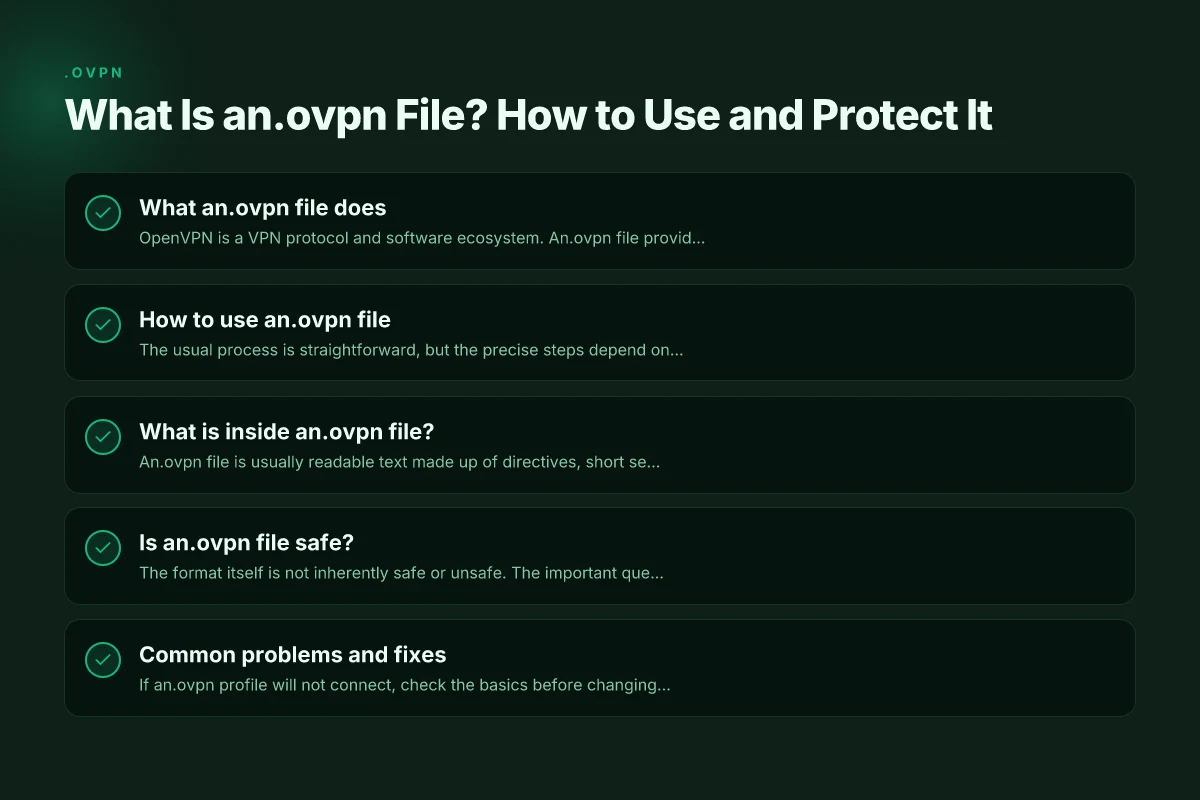
OpenVPN is a VPN protocol and software ecosystem. An.ovpn file provides settings that an OpenVPN client needs to connect to a particular VPN server. It is typically a plain-text file, so it can be opened in a text editor, but its settings are intended to be read and applied by compatible VPN software.
Depending on who created it, a configuration may specify:
- The VPN server’s address and port
- The transport protocol, such as UDP or TCP
- Encryption and authentication options
- Certificate or key references
- DNS or routing behavior
- Whether certificates or keys are embedded in the file
The exact contents vary. Some providers give you one configuration for each server or location. Others supply a single file that works with additional login details.
An.ovpn file generally does not include the VPN app, an active subscription, or all the credentials needed to sign in. Your provider may separately ask for a username and password, a one-time code, or another authentication method. Best Free VPN for Microsoft Edge: Safe Options and What to Know
How to use an.ovpn file
The usual process is straightforward, but the precise steps depend on your device and VPN provider.
- Get the file from a trusted source. Download it from your VPN provider’s official account page or obtain it from your workplace or network administrator.
- Install a compatible client. Use the VPN provider’s recommended app or an official OpenVPN client that supports imported configurations.
- Import the configuration. In the app, choose an option such as “Import profile” or “Add configuration,” then select the.ovpn file.
- Enter credentials if requested. Follow the provider’s instructions. The file alone may not authenticate you.
- Connect and verify. Select the imported profile and connect. Check the app’s status and, if needed, confirm that your public IP address reflects the VPN connection.
Some apps let you open the downloaded file directly to begin importing it. Others require you to browse to it from within the app. On mobile devices, you may need to approve the profile import or allow the app to add a VPN configuration.
If you receive a separate certificate or key file, keep it in the location specified by the provider. Some.ovpn files refer to those files by name rather than containing their contents.
Check what an .ovpn file contains and how sensitive it is Best Free VPN Extension for Edge Browser: Top Picks and How to Choose
| File content | Purpose | Usually secret? | Handle with care? | What to check |
|---|---|---|---|---|
| Remote server address | Identifies the VPN server | No | Yes | Confirm it came from your provider |
| Protocol and port | Defines connection transport | No | Yes | Match provider instructions |
| CA certificate | Verifies the server | No | Yes | Keep it intact |
| Client certificate | Identifies the client | Often | Yes | Protect it from unauthorized access |
| Private key | Proves client identity | Yes | Yes | Never post or send publicly |
| Username and password | Authenticates the account | Yes | Yes | Keep credentials out of shared files |
| Cipher and TLS settings | Configure encryption and security | No | Yes | Do not weaken provider settings |
| Inline certificates or keys | Store credentials inside the profile | May be | Yes | Treat the whole file as sensitive |
Compiled November 2026; check the provider's site for current details.
What is inside an.ovpn file?
An.ovpn file is usually readable text made up of directives, short settings that tell the client how to connect. A simplified configuration might include a server address, a port, a protocol, and references to certificates. Real files may be much longer and can contain technical settings that should not be changed casually.
| File feature | What it may provide | What to know |
|---|---|---|
| Server and port | The destination for the VPN connection | These values are often specific to a server or region |
| Protocol and connection settings | How the client communicates with the server | Changing them may prevent a connection |
| Certificate references | Information used to verify the server or client | Related certificate files may be required |
| Embedded certificate or key blocks | Authentication material within the configuration | Treat these files as sensitive |
| Routing or DNS directives | How network traffic is handled while connected | Behavior depends on the provider and client |
Seeing certificate text in a file does not necessarily mean it contains your personal password. However, certificates, keys, and configuration details can still be sensitive. A file that grants access to a private VPN should be handled as a credential.
Avoid editing settings unless your VPN provider or administrator tells you what to change. A small error, such as a wrong server name or missing certificate, can stop the connection from working or alter how traffic is routed. Best VPN Extension for Edge Free: Top Options and How to Choose
Is an.ovpn file safe?
The format itself is not inherently safe or unsafe. The important questions are who supplied the file and what the configuration asks the VPN client to do. A modified file could direct your client to an untrusted server or apply settings you did not expect.
Use these precautions:
- Download configurations only from official provider sites or a trusted administrator.
- Be cautious with files shared through public forums, unknown links, or unsolicited messages.
- Do not upload an unredacted configuration to public websites or support forums.
- Store the file somewhere others cannot access, especially if it includes private keys.
- Remove old profiles and related credentials when you no longer need them.
- If you suspect a file has been exposed, ask the provider or administrator whether its certificates or credentials should be revoked.
A plain-text file can often be inspected, but that does not make it easy to verify. VPN settings can be technical, and a suspicious or unfamiliar directive is not always obvious to a new user. When in doubt, request a fresh configuration from the source rather than trying to repair an uncertain file.
Troubleshoot common .ovpn problems DayZ You Were Kicked Off the Game Battleye VPN Detected: How to Fix It
| Problem | Likely cause | First check | Possible fix | Avoid |
|---|---|---|---|---|
| Profile will not import | Unsupported format or app | Use an OpenVPN-compatible app | Download a fresh profile | Renaming unrelated files |
| Authentication fails | Incorrect or expired credentials | Check provider login details | Update credentials or contact provider | Sharing passwords |
| Cannot reach server | Network issue or wrong address | Check internet and server entry | Try another provider server | Editing server details at random |
| TLS or certificate error | Missing, invalid, or outdated certificate | Compare with provider instructions | Re-download the profile | Removing certificate checks |
| Connection times out | Firewall, blocked port, or server outage | Test another network or server | Allow the VPN app through the firewall | Disabling the firewall entirely |
| Connected but no internet | DNS or routing configuration issue | Check provider status and profile | Re-import the correct profile | Changing security options blindly |
| Connection drops | Unstable network or server | Test the connection on another network | Choose a more stable server | Assuming the profile is harmless to share |
| Unexpected profile contents | Untrusted or altered file | Verify its source | Delete it and get a trusted copy | Importing unknown profiles |
Compiled November 2026; check the provider's site for current details.
Common problems and fixes
If an.ovpn profile will not connect, check the basics before changing advanced settings:
- The import fails: Confirm that you selected a valid.ovpn file and that the app supports OpenVPN configurations.
- The app asks for a username or password: Use the credentials supplied for VPN access. These may differ from your website account password.
- A certificate or key is missing: Download the complete configuration package, or follow the provider’s instructions for placing separate files.
- The server cannot be reached: Check your internet connection, try another approved server profile, and see whether the provider reports an outage.
- The connection works on one device but not another: Make sure the client is compatible and up to date, and re-import a current configuration if required.
- The profile is outdated: VPN providers may change servers or certificates. Download a new file from the official source.
Do not disable security checks just to make a connection succeed. If the app reports a certificate error or an unexpected server identity, stop and contact the provider or administrator.
Recommendation
Use an.ovpn file when your VPN provider or network administrator specifically supplies one, and import it with a trusted OpenVPN-compatible app. Keep the original file private, avoid changing its settings without guidance, and request an updated configuration from the source if it stops working or seems suspicious. Surfshark Won’t Connect? Try These Fixes