Microsoft Edge Menu > Settings > Show Advanced Settings > Change Proxy Settings > LAN Settings
Find LAN proxy settings in Microsoft Edge, understand the Windows options, and troubleshoot connection problems safely.
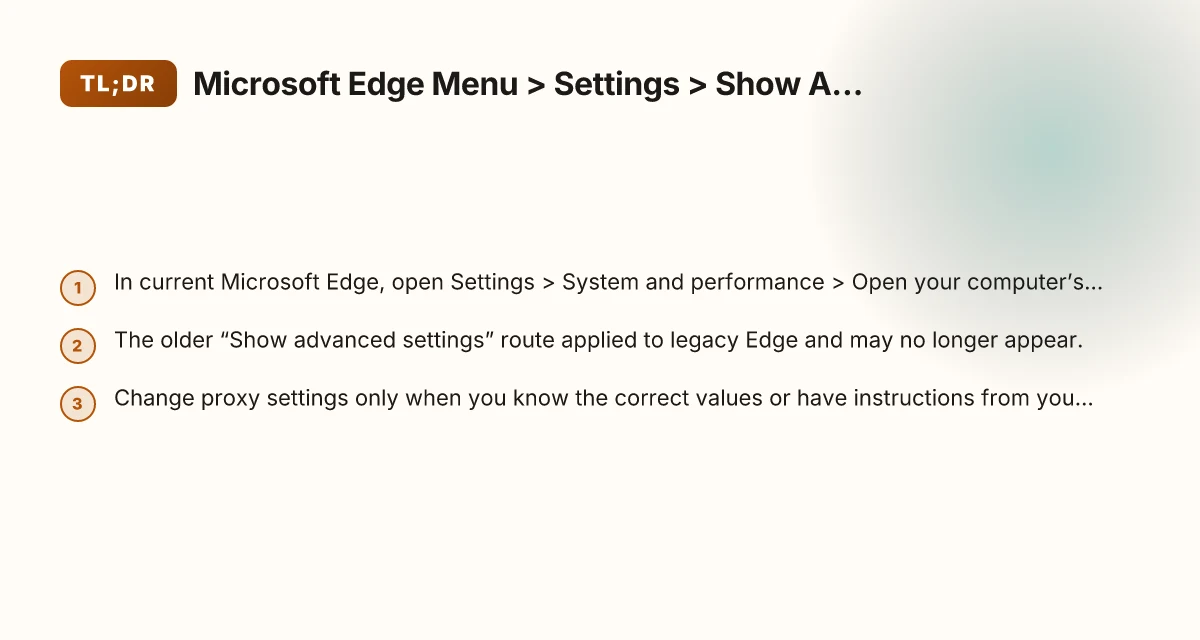
If you are following the path “Microsoft Edge menu > Settings > Show advanced settings > Change proxy settings > LAN settings,” you are looking for your computer’s local network proxy controls. In current Microsoft Edge, select the three-dot menu, choose Settings, open System and performance, and select Open your computer’s proxy settings. The LAN settings are then managed by Windows, not by a separate Edge settings page.
The exact Windows screens vary by version. On Windows 11, the link opens Settings > Network & internet > Proxy. On Windows 10, it typically opens Settings > Network & Internet > Proxy. For the classic LAN Settings dialog, you can also open Internet Properties and select Connections > LAN settings.

Editor's pick: NordVPN — fast, secure VPN — Strong encryption, a no-logs policy and apps for every device. 30-day money-back guarantee. Get NordVPN →
Choose the route that matches your Edge and Windows setup
| Route | Best for | What to open | Where to look next | Key consideration |
|---|---|---|---|---|
| Current Edge menu | Most current Edge versions | Settings | System and performance | Menu labels can vary |
| Edge system settings | Finding Windows network options | System and performance | Open your computer’s proxy settings | Opens Windows settings |
| Windows Settings | Direct access in Windows | Network & internet | Proxy | Names can vary by Windows version |
| Windows Control Panel | Finding classic LAN options | Internet Options | Connections | Available in Windows |
| Connections tab | Reaching LAN Settings | LAN settings | Local Area Network settings | May be called LAN Settings |
| Old Edge menu path | Following an older guide | Show Advanced Settings | Change Proxy Settings | May no longer appear |
| Managed device route | Work or school computer | Organization’s instructions | IT support | Policies may control proxy settings |
Compiled November 2026; check the provider's site for current details.
Why the old menu path may not appear
The wording in the keyword comes from an older version of Microsoft Edge. Legacy Edge included a Show advanced settings option and a link to change proxy settings. Modern Edge is based on Chromium and generally sends you to the operating system’s proxy controls instead.
That distinction matters: Edge usually uses Windows’ system proxy configuration, so changing it can affect other apps as well as the browser. If your computer is managed by an employer, school, or other organization, some controls may be set by policy and unavailable for you to change.
Open proxy settings from current Microsoft Edge
Use this route first:
- Open Microsoft Edge.
- Select the three-dot menu in the upper-right corner.
- Select Settings.
- Choose System and performance.
- Select Open your computer’s proxy settings.
Windows will open its proxy controls. You may see options for automatic setup, a setup script, and a manual proxy server. The labels and layout can differ slightly depending on your Windows version. NordVPN Download Windows 11: How to Get and Install the App
If you do not see System and performance, use the Settings search box and search for proxy. You can also open Windows Settings directly and search for Proxy settings.
Check these details before changing a proxy
| Check | What to confirm | If confirmed | If unknown | Safer next step |
|---|---|---|---|---|
| Proxy address | Exact server or address | Enter as provided | Do not guess | Ask the provider |
| Port | Correct port number | Enter as provided | Leave unchanged | Confirm with IT |
| Proxy type | Required configuration type | Match the instructions | Avoid choosing at random | Check provider guidance |
| Automatic setup | Whether a setup script is required | Use the supplied details | Do not invent a script URL | Ask the administrator |
| Organization policy | Whether proxy settings are managed | Follow the policy | Avoid overriding settings | Contact IT support |
| Current configuration | Whether existing settings are needed | Record them first | Do not erase them | Take a note or screenshot |
| Connection scope | Which apps or traffic should use it | Match the intended use | Do not assume coverage | Check the instructions |
Compiled November 2026; check the provider's site for current details.
Find LAN Settings in Windows
To reach the classic LAN dialog, use either of these methods: Checkpoint VPN: What It Does, How It Works, and Which Client to Use
- Press Windows + R, type
inetcpl.cpl, and press Enter. In Internet Properties, select Connections, then LAN settings. - Open Windows Settings and search for Internet Options. Select the result, then go to Connections > LAN settings.
In the LAN Settings dialog, you may see controls such as Automatically detect settings, Use automatic configuration script, and Use a proxy server for your LAN. Not every computer needs a manually configured proxy.
| Setting | What it does | When it is commonly used |
|---|---|---|
| Automatically detect settings | Lets Windows look for network configuration automatically | Networks that provide automatic proxy discovery |
| Use automatic configuration script | Applies settings from a supplied script address | Organizations that provide a PAC file |
| Use a proxy server for your LAN | Sends eligible traffic through a specified proxy address and port | Networks that provide a proxy server and connection details |
Do not enable an option or enter an address simply to test it. Incorrect proxy details can prevent websites or apps from connecting.
Change a proxy only with the right information
If a network administrator or service provider has given you proxy details, follow their instructions exactly. Depending on the setup, you may need to enter a script address, a server address and port, or exceptions for local addresses. The required fields vary, so there is no universal proxy value to enter.
Before making a change, note or capture the existing settings. Then: Free VPN That Changes Location: What to Know Before You Connect
- Open the Windows proxy controls or the classic LAN Settings dialog.
- Change only the option specified by your administrator or provider.
- Enter the supplied address and port, if requested.
- Confirm the dialogs and restart Edge if the connection does not update immediately.
If the computer belongs to an organization, check with its IT team before changing settings. A proxy may be required for access to internal websites, security filtering, or other network services.
Troubleshoot common proxy problems
If Edge cannot load pages after a change, return to the same proxy screen and verify the values against the instructions you received. Check for typos, missing port numbers, or a script address copied with extra spaces.
If you did not intend to use a proxy and no organization requires one, review whether a manual proxy or script was enabled accidentally. Turn it off only if you are sure the device is not managed and the network does not require it. Some settings may be controlled by policy, in which case Windows may show a notice or prevent changes.
Other useful checks include: Fortinet VPN: What It Does, How to Set It Up, and What to Know
- Test another browser or app to see whether the problem affects the whole computer.
- Disconnect from a VPN temporarily, if permitted, because VPN software may manage network routing or proxy settings.
- Restart Edge, then reconnect to the network.
- Ask your network administrator whether the proxy address or configuration script has changed.
Troubleshoot proxy problems by symptom
| Symptom | First check | Possible cause | Recommended action | When to seek help |
|---|---|---|---|---|
| Old menu path is missing | Edge version and menu labels | Settings layout has changed | Open current Edge settings | If Windows options are unavailable |
| LAN Settings is hard to find | Internet Options and Connections | Looking in the wrong area | Open Connections, then LAN settings | If the tab is missing |
| Websites do not load | Proxy address and port | Incorrect server details | Compare with supplied instructions | If details are correct |
| Proxy authentication fails | Credentials and access rights | Invalid or missing sign-in | Confirm the required credentials | If access is denied |
| Only some apps connect | App-specific proxy behavior | The app may use separate settings | Check that app’s network options | If the app’s setup is unclear |
| Settings keep changing | Device management or policy | Organization-managed configuration | Check with the administrator | If settings are locked |
| Connection fails after a change | Previous configuration | A setting was altered incorrectly | Restore recorded settings if available | If the connection stays unavailable |
Compiled November 2026; check the provider's site for current details.
Recommendation
For current Microsoft Edge, use Settings > System and performance > Open your computer’s proxy settings. To reach the older LAN Settings dialog, open Internet Properties and select Connections > LAN settings. Keep the existing configuration unless you have accurate instructions for changing it, especially on a work or school device.