
Use Proxy Connections Safely: A Practical Guide
Learn when to use a proxy, how to choose a type, and how to configure and test it safely.
To use a proxy, choose a trustworthy provider, enter its server details in your device, browser, or application, and confirm that the connection works as expected. A proxy forwards requests between you and online services, so those services may see the proxy’s IP address instead of yours. The right setup depends on what you need the proxy to do, and you should understand its privacy and security limits before routing sensitive traffic through it.

Editor's pick: NordVPN — fast, secure VPN — Strong encryption, a no-logs policy and apps for every device. 30-day money-back guarantee. Get NordVPN →
Compare proxy types by use case
| Proxy type | Common use | Traffic coverage | Typical advantage | Key limitation |
|---|---|---|---|---|
| HTTP proxy | Web browsing | HTTP traffic | Simple for web requests | Does not protect other apps |
| HTTPS proxy | Secure websites | HTTPS traffic | Encrypts the connection to the proxy | Proxy operator can still see metadata |
| SOCKS5 proxy | Apps and varied traffic | App-dependent | Flexible protocol support | Encryption is not inherent |
| Residential proxy | Location-sensitive tasks | App-dependent | Uses residential IP addresses | Provider practices vary |
| Datacenter proxy | High-volume requests | App-dependent | Fast and easy to scale | IPs may be easier to identify |
| Transparent proxy | Managed networks | Often selected traffic | May need no device setup | User may have limited control |
Compiled November 2026; check the provider's site for current details.
What a proxy does
A proxy server acts as an intermediary between your device and a website or other internet service. Instead of connecting directly, your device sends a request to the proxy, which forwards it and returns the response.
People use proxies for several legitimate reasons:
- Accessing an organization’s network through an approved gateway
- Testing how a website appears from different regions
- Applying company filtering, monitoring, or access rules
- Routing application traffic through a designated server
- Separating a website’s view of a connection from a user’s direct IP address
A proxy is not the same as a VPN. A VPN typically creates an encrypted tunnel for traffic from a device or network, while a proxy may handle only traffic from a particular browser or app. Some proxies support encryption between your device and the proxy, but others do not.
Choose the right type
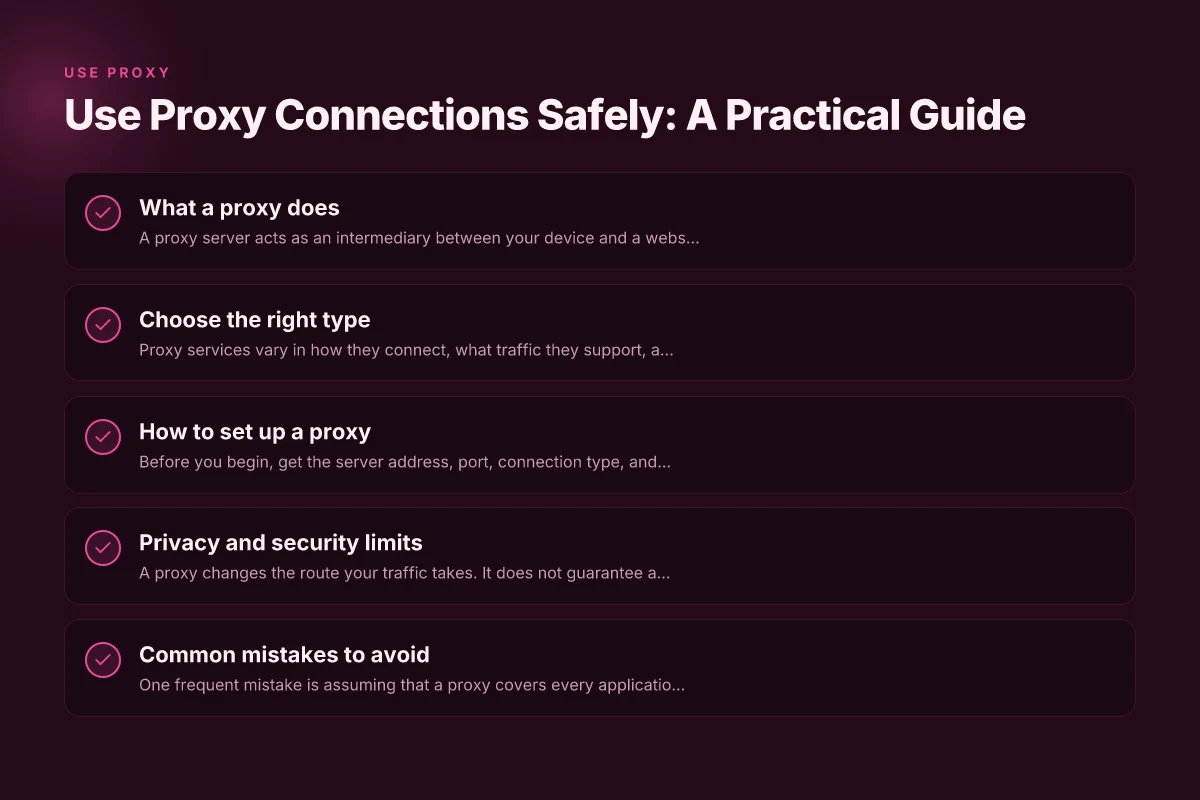
Proxy services vary in how they connect, what traffic they support, and where their IP addresses come from. Check the provider’s documentation rather than assuming every proxy offers the same protections or capabilities. FortiGate VPN PFS: What It Is and How to Configure It
| Proxy type | Common use | What to check |
|---|---|---|
| HTTP or HTTPS proxy | Web traffic from a browser or compatible app | Whether HTTPS traffic is supported and how connections are secured |
| SOCKS5 proxy | Applications that support a general-purpose proxy connection | Which traffic and authentication methods the app supports |
| Residential proxy | Testing or access scenarios that require an IP associated with a residential network | Provider consent, sourcing practices, pricing, and terms |
| Datacenter proxy | Fast, predictable connections for suitable business or technical tasks | Whether the destination service accepts the IP range |
| Transparent proxy | Managed network filtering or caching | Whether the network administrator has disclosed its use |
Residential and datacenter describe the source or hosting of an IP address; HTTP and SOCKS describe ways traffic can be handled. These are different characteristics, and a service may combine them. No type is automatically private, safe, or appropriate for every purpose.
How to set up a proxy
Before you begin, get the server address, port, connection type, and any required username or password from your provider or network administrator. Do not use proxy details found in random online lists: public proxies may be unstable, monitored, or operated by unknown parties.
Configure a browser or device
The exact steps depend on your operating system, browser, and proxy provider. In general:
- Open the network or proxy settings for your device, browser, or application.
- Select manual proxy configuration, or choose the system proxy if your administrator instructs you to.
- Enter the proxy host and port.
- Choose the correct protocol, such as HTTP or SOCKS5.
- Add authentication details only through the provider’s official configuration process.
- Save the settings and reconnect to the network.
Some applications ignore system-wide proxy settings and need their own configuration. Others may not support proxies at all. Follow the app’s current instructions, and avoid copying credentials into shared documents or untrusted extensions. FortiClient VPN 7.2 Download: Safe Sources, Installation, and Setup
Test the connection
After setup, check that the proxy is active in the specific app you plan to use. A reputable IP-checking service can show the public IP address that a browser presents to a website. You can also test whether the expected site loads and whether the connection is stable.
Check for common problems:
- An incorrect host, port, or protocol
- Expired or mistyped credentials
- A proxy that is unavailable or overloaded
- An application that bypasses system proxy settings
- Network rules that block the connection
If traffic is sensitive, confirm whether the connection to the proxy is encrypted. A proxy provider may be able to see connection details, and unencrypted traffic can expose information in transit. Use HTTPS websites and follow your organization’s security guidance.
Choose a setup method Catvpn Review: What It Is, How It Works, and What to Check
| Method | Best suited to | Setup location | App coverage | Main check |
|---|---|---|---|---|
| Operating system settings | Most device traffic | Device settings | Broad, but varies by app | Confirm apps follow system settings |
| Browser settings | Web browsing | Browser settings | Browser only | Check HTTPS and proxy details |
| App-specific settings | One app or service | App settings | Selected app | Verify the app supports the proxy type |
| Proxy auto-configuration (PAC) | Managed or changing routes | Browser or device | Depends on configuration | Use a trusted PAC file |
| Network-managed proxy | Workplace or school access | Network administrator | Network-dependent | Confirm policy and logging |
| Command-line configuration | Developer tools | Tool or shell settings | Configured tools only | Avoid exposing credentials |
Compiled November 2026; check the provider's site for current details.
Privacy and security limits
A proxy changes the route your traffic takes. It does not guarantee anonymity. Websites may still identify you through account sign-ins, cookies, browser settings, or other information. The proxy operator may also be able to observe connection metadata and, depending on the setup, some traffic content.
For safer use:
- Choose a provider with clear ownership, privacy terms, and support information.
- Check how the provider obtains and manages its IP addresses.
- Avoid sending passwords, payment details, or confidential data through an untrusted proxy.
- Keep your browser and operating system updated.
- Do not treat an unfamiliar proxy as a substitute for an approved security tool.
- Review local rules, workplace policies, and the destination service’s terms.
Free services deserve particular caution. “Free” does not establish how a provider pays its costs, handles data, or maintains its servers. Read the terms and avoid services that make unrealistic claims or request unnecessary access to your device. Best Free VPN Extensions for Microsoft Edge: What to Know
Common mistakes to avoid
One frequent mistake is assuming that a proxy covers every application on a device. A browser may use the proxy while another app connects directly. Check settings for each app and test the specific traffic you care about.
Another mistake is treating a changed IP address as proof of privacy. Your logged-in accounts and browser identifiers can still connect activity to you. A proxy also may not encrypt the connection between your device and the proxy, so verify the protocol and security features rather than relying on the word “proxy.”
Finally, do not use a proxy to violate a service’s rules, bypass access controls, or collect information without authorization. A technically working connection does not make an activity permitted or ethical.
Check safety and reliability before connecting Free VPN Extension for Microsoft Edge Browser: What to Choose
| Check | Safer choice | Warning sign | What to do |
|---|---|---|---|
| Provider reputation | Clear ownership and policies | Anonymous operator | Research the provider |
| HTTPS use | Secure sites with valid certificates | Certificate warnings | Stop and investigate |
| Logging policy | Specific, understandable terms | Vague retention claims | Avoid sharing sensitive data |
| Credentials | Unique, protected credentials | Reused or publicly shared login | Change credentials |
| Free service claims | Transparent limits and funding | “Unlimited” with no explanation | Check how it is funded |
| DNS handling | Documented DNS behavior | Unknown routing | Test for DNS leaks |
| App coverage | Confirmed proxy support | Assuming every app is routed | Verify each app |
| Connection testing | Check IP and leak behavior | No verification | Test before sensitive use |
Compiled November 2026; check the provider's site for current details.
Recommendation
Use a proxy when you have a clear, legitimate reason and a provider or administrator you can trust. Choose a type that supports your application, configure it using verified instructions, and test both connectivity and privacy limits. If you need encrypted protection for all device traffic, consider an approved VPN or other security solution instead of assuming a proxy provides the same coverage.