
VPN FortiGate: How It Works, Setup Options, and Best Practices
Learn how VPN FortiGate connections work, which type to choose, and how to configure and secure them.
A VPN FortiGate deployment uses a FortiGate next-generation firewall to create encrypted connections between remote users, offices, or cloud networks. Organizations commonly use FortiGate for remote access and site-to-site VPNs, with the right setup depending on who needs to connect and which networks they must reach. A secure deployment also requires more than enabling a tunnel: authentication, firewall policies, routing, and ongoing maintenance all matter.

Editor's pick: NordVPN — fast, secure VPN — Strong encryption, a no-logs policy and apps for every device. 30-day money-back guarantee. Get NordVPN →
FortiGate VPN options at a glance
| Comparison point | IPsec VPN | SSL VPN |
|---|---|---|
| Common use | Site-to-site and remote access | Remote access |
| Typical connection scope | Networks or individual devices | Individual users and devices |
| Client requirements | Depends on setup | Browser or compatible client, depending on setup |
| Network access | Can connect networks or hosts | Can provide user access to network resources |
| Configuration focus | Tunnels, peers, and routing | Portal, authentication, and access rules |
| Best fit | Connecting offices or networks | Providing flexible remote-user access |
Compiled November 2026; check the provider's site for current details.
| VPN | Obfuscation | From / month | Plan | Free plan | Refund | Alipay | UnionPay | Crypto | Website opens in China | Trustpilot | |
|---|---|---|---|---|---|---|---|---|---|---|---|
 ZoogVPN | Turn on manually Shadow | $2.49/mo | 27 months: $59.99 | Yes | 7 days | ✓ | ✓ | ✓ | ✓ | Official site blocked; our special link opens (4.4 s) | 4.2/5 (195 reviews) |
 NordVPN | Turn on manually Obfuscated Servers / NordWhisper | $3.49/mo | 27 months: $94.23 | No | 30 days | ? | ✗ | ✓ | ✓ | ✗ Blocked | 4.2/5 (51,628 reviews) |
 ExpressVPN | ✓ On by default all servers | $3.00/mo | 28 months: $84 | No | 30 days | ✗ | ✗ | ✓ | ✗ | ✗ Blocked | 4.4/5 (29,706 reviews) |
 Surfshark | ✓ On by default Camouflage, with OpenVPN | See site | See site | No | 30 days | ✗ | ✗ | ✗ | ✓ | ✗ Blocked | 4.3/5 (31,823 reviews) |
 Proton VPN | Turn on manually Stealth, free plan too | $2.99/mo | 12 months: $35.88 | Yes | 30 days | ✗ | ✗ | ✗ | ✓ | ✗ Blocked | 2.1/5 (1,040 reviews) |
 Astrill VPN | Turn on manually StealthVPN / OpenWeb | $12.50/mo | 24 months: $300 | No | See site | ✗ | ✗ | ✗ | ✓ | ✗ Blocked | 1.3/5 (110 reviews) |
 Private Internet Access | Turn on manually Shadowsocks, OpenVPN only | $2.03/mo | 40 months: $81.2 | No | 30 days | ✗ | ✗ | ✗ | ✗ | ✗ Blocked | 4.2/5 (11,033 reviews) |
 CyberGhost | Turn on manually selected servers | $2.19/mo | 28 months: $61.32 | No | 45 days | ✗ | ✗ | ✗ | ✓ | ✗ Blocked | 4.0/5 (24,178 reviews) |
 PureVPN | Turn on manually switch to OpenVPN | $1.69/mo | 60 months: $101.55 | No | 31 days | ? | ? | ✗ | ✓ | ✗ Blocked | 4.4/5 (17,994 reviews) |
 AdGuard VPN | ✓ On by default TrustTunnel | $2.99/mo | 24 months: $71.76 | Yes | 30 days | ✓ | ✗ | ✓ | ✓ | Official site blocked; our special link opens (3.7 s) | 4.3/5 (290 reviews) |
 Mullvad | Turn on manually QUIC / Shadowsocks / LWO | $5.61/mo | €5/mo | No | 14 days | ✗ | ✗ | ✗ | ✓ | ✗ Blocked | 3.2/5 (192 reviews) |
 Windscribe | Turn on manually Stealth / WStunnel | $5.75/mo | 12 months: $69 | Yes | See site | ✗ | ✗ | ✗ | ✓ | ✗ Blocked | 4.7/5 (13,355 reviews) |
 StrongVPN | Turn on manually Scramble, OpenVPN TCP | See site | See site | No | 30 days | ✓ | ✗ | ✗ | ✗ | ✗ Blocked | 4.4/5 (2,695 reviews) |
 LightXtreme 闪连 | Not listed | $7.08/mo | 12 months: $84.99 | Yes | 30 days | ✓ | ✓ | ✓ | ✓ | ✓ Yes (3.5 s) | No page |
Prices checked 2026-11-10 on each vendor's pricing page (cheapest long plan, USD). Check the vendor's checkout for the final price.
Obfuscation checked 2026-11-14 on each vendor's site and help center: "on by default" = nothing to set; "turn on manually" = switch protocol or mode in settings; "not listed" = the vendor describes no obfuscation.
Payment methods checked 2026-11-10 on each vendor's payment pages: all 14 take cards and PayPal; ✗ = not listed, ? = the vendor's own pages disagree.
China access: whether the official website opens from mainland China networks (tests the website only, not the VPN connection). Last checked 2026-11-18 01:02 Beijing time.
Trustpilot score and review count checked 2026-11-10.
What is a FortiGate VPN?
FortiGate is Fortinet’s family of network security appliances and virtual firewalls. A VPN, or virtual private network, encrypts traffic traveling over an untrusted network, such as the public internet. The FortiGate device manages the connection and applies security and access rules to traffic passing through it.
There are two common use cases:
- Remote-access VPN: Individual employees connect from laptops or mobile devices to a company network.
- Site-to-site VPN: Two or more networks connect through encrypted tunnels, often linking offices or a data center with a cloud environment.
A VPN tunnel does not automatically grant access to every internal resource. Administrators define which users or networks can communicate, using firewall policies and routing.
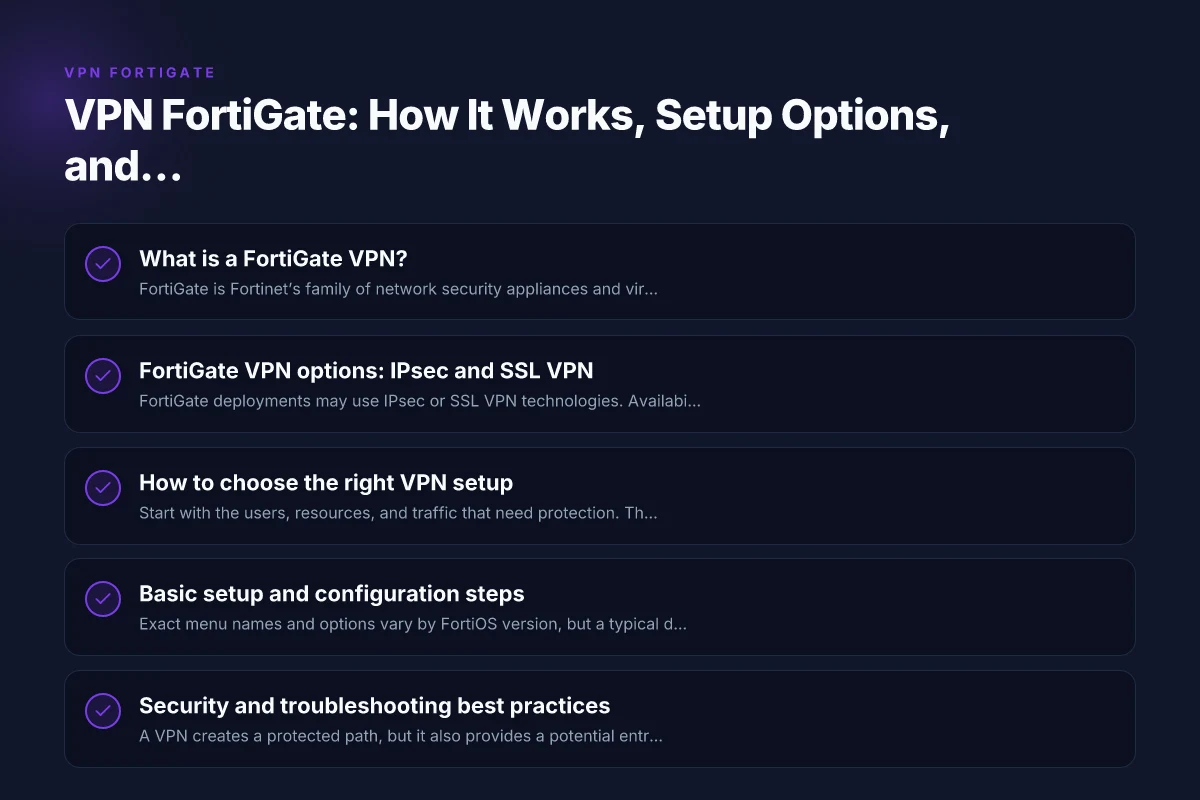
FortiGate VPN options: IPsec and SSL VPN
FortiGate deployments may use IPsec or SSL VPN technologies. Availability and recommended configurations can vary by FortiOS version, model, and client platform, so check Fortinet’s current documentation before choosing an approach. Com.NordVPN.Android: What It Is and How to Use the NordVPN App
| Option | Common use | Typical considerations |
|---|---|---|
| IPsec VPN | Remote access and site-to-site connections | Widely used, supports strong encryption, and requires compatible client and network settings |
| SSL VPN | Remote access in supported FortiOS configurations | Often convenient for user access, but feature availability and setup depend on FortiOS version and platform |
IPsec is a widely adopted VPN protocol suite. It can protect traffic between networks or provide remote users with access through a compatible client. Site-to-site IPsec tunnels are commonly used to connect fixed networks.
SSL VPN has traditionally provided remote users with browser-based or client-based access, depending on the configuration. Fortinet has changed SSL VPN support and recommendations across some products and software versions. Verify that the feature is available and supported for your specific FortiGate and FortiOS release rather than relying on an older guide.
Choosing a FortiGate VPN setup
| Need | Suggested option | Main consideration | Planning question |
|---|---|---|---|
| Connect office networks | IPsec site-to-site | Coordinate tunnel settings at both ends | Which networks should communicate? |
| Give staff remote access | IPsec or SSL VPN | Match the option to client and access needs | What devices will users connect from? |
| Provide browser-based access | SSL VPN, where supported | Confirm FortiOS and device support | Do users need a browser-based connection? |
| Limit access to specific resources | Either option | Apply narrowly scoped policies | Which resources does each user need? |
| Support managed devices | Either option | Choose compatible clients and authentication | Which clients can IT manage? |
| Connect users with varied devices | Evaluate SSL VPN support | Verify compatibility and security requirements | Which operating systems must be supported? |
Compiled November 2026; check the provider's site for current details. Certificate Validation Failure Cisco VPN: Causes and Fixes
How to choose the right VPN setup
Start with the users, resources, and traffic that need protection. The best option is not necessarily the one with the fewest setup steps. It is the one that meets operational needs while limiting exposure.
Choose a remote-access VPN when staff need to connect from outside the office. Decide whether users need access to the whole internal network or only specific applications. Restricting access to the required resources reduces risk if an account or device is compromised.
Choose a site-to-site VPN when networks need a persistent connection, such as between two office locations. Before configuring it, confirm that both sides use compatible encryption settings, have non-conflicting IP address ranges, and have clear routing rules.
Consider these questions: Forticlientvpnonlineinstaller: Download, Install, and Troubleshoot FortiClient VPN
- Which FortiOS version and FortiGate model are in use?
- Do users need full network access, application-specific access, or only a single service?
- Will authentication use local accounts, a directory service, or a multi-factor authentication provider?
- Are the networks on each side using overlapping IP ranges?
- How will administrators monitor availability and investigate failed connections?
Basic setup and configuration steps
Exact menu names and options vary by FortiOS version, but a typical deployment follows the same broad sequence. Use the official Fortinet administration guide for version-specific instructions.
- Plan the network design. Identify the users or remote networks, the protected subnets, the public-facing interface, and the routes traffic must follow.
- Select the VPN type. Choose remote access or site-to-site, then select a supported protocol and client approach.
- Configure authentication. Use named user groups and strong credentials. Enable multi-factor authentication where supported, particularly for remote access.
- Set encryption parameters. Select secure, mutually supported cryptographic settings. Avoid obsolete algorithms and protocols.
- Create firewall policies. Allow only necessary traffic between the VPN interface or user group and internal resources. Do not assume that creating a tunnel also creates a safe access policy.
- Configure routing and DNS. Ensure clients or remote networks know how to reach permitted destinations and can resolve required internal names.
- Test and document. Verify access from an external network, confirm that unauthorized destinations remain blocked, and record the configuration and recovery steps.
For remote-access users, consider whether split tunneling is appropriate. With split tunneling, only traffic intended for company networks goes through the VPN. Other internet traffic travels directly from the user’s device. This can reduce VPN bandwidth demands, but it may not suit every security policy. A full-tunnel configuration sends more traffic through the organization’s security controls but requires adequate capacity.
Security and troubleshooting best practices
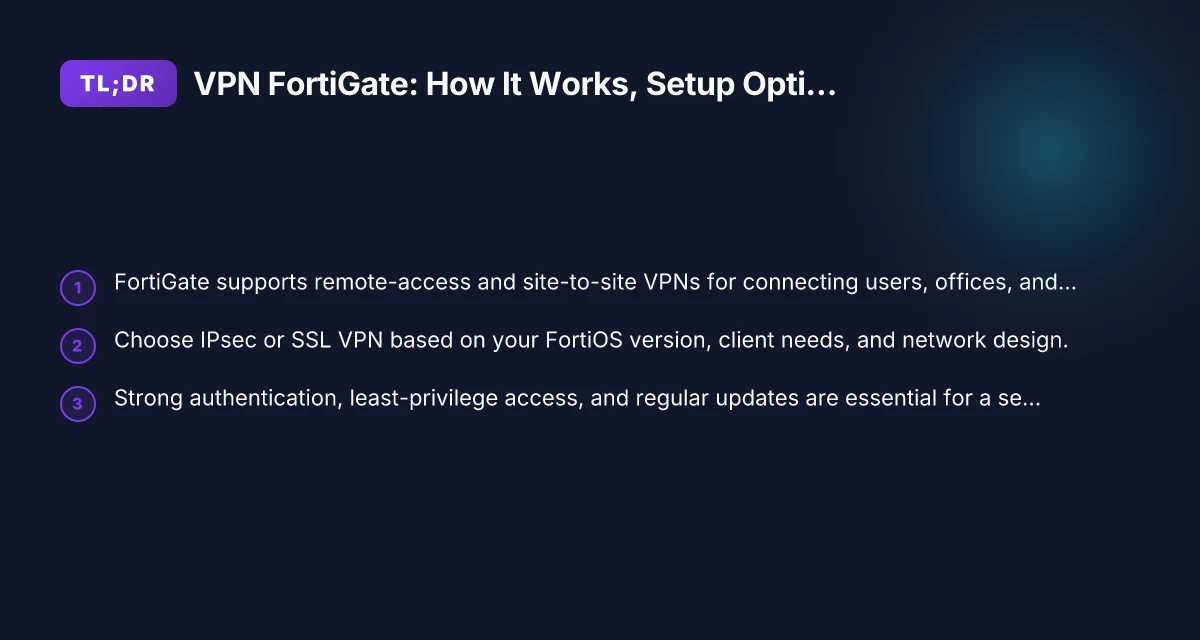
A VPN creates a protected path, but it also provides a potential entry point into the network. Treat VPN access as part of your security perimeter.
- Apply least privilege: Give users access only to the systems and ports they need.
- Use multi-factor authentication: Add a second verification step, especially for administrator and remote-user accounts.
- Keep FortiOS and VPN clients current: Review security advisories and follow supported upgrade guidance.
- Limit administrative exposure: Restrict management access to trusted networks and authorized administrators.
- Monitor logs: Review authentication failures, unusual connection times, and unexpected traffic.
- Test changes carefully: Validate changes in a controlled manner and keep a rollback plan.
If a connection fails, check the basics before changing security settings. Confirm that the user account is active, the client settings match the FortiGate configuration, and the device can reach the VPN’s public address. For site-to-site connections, compare tunnel parameters on both ends, check firewall policies and routes, and look for overlapping subnets. FortiGate event and VPN logs can help identify whether a problem involves authentication, negotiation, routing, or traffic permissions. Free VPN Extension for Microsoft Edge: Best Options and Safe Setup
FortiGate VPN setup and security checklist
| Stage | Action | What to check | Common issue |
|---|---|---|---|
| Plan | Choose IPsec or SSL VPN | Users, networks, and access needs | Option does not match the use case |
| Prepare | Confirm FortiGate and client support | FortiOS version and device compatibility | Unsupported feature or client |
| Configure | Set up the VPN and authentication | Peers, users, and connection settings | Mismatched settings |
| Control access | Add policies for required resources | Routes, policies, and least privilege | Tunnel connects but traffic is blocked |
| Protect | Use strong authentication and secure settings | Credentials, certificates, and permitted access | Weak or outdated configuration |
| Test | Verify connection and resource access | Client status, routes, and policy matches | Incorrect routing or policy |
| Maintain | Review logs and configuration | Recent changes and recurring errors | Changes go unnoticed |
Compiled November 2026; check the provider's site for current details.
Recommendation
For a VPN FortiGate deployment, begin by choosing the connection type that fits your use case: remote access for individual users or site-to-site for network links. Confirm feature support for your FortiOS version, use strong authentication and current encryption, and define narrow firewall policies. If the VPN will protect business-critical access, have a qualified network administrator review the design, test recovery procedures, and monitor it after launch.