
Forti VPN Client: Setup, Features, and Troubleshooting
Learn what the Forti VPN client does, how to connect, and how to troubleshoot common VPN issues.
The Forti VPN client is software for connecting a computer or mobile device to a network protected by Fortinet security products. It is commonly used by employees and contractors to access work resources remotely. To connect, install the appropriate client, enter the VPN settings supplied by your organization, and authenticate with your approved credentials.
The exact setup depends on your device and the VPN configuration your organization uses. If you are unsure which client or settings to use, ask your IT team before downloading or changing anything.
| VPN | Obfuscation | From / month | Plan | Free plan | Refund | Alipay | UnionPay | Crypto | Website opens in China | Trustpilot | |
|---|---|---|---|---|---|---|---|---|---|---|---|
 ZoogVPN | Turn on manually Shadow | $2.49/mo | 27 months: $59.99 | Yes | 7 days | ✓ | ✓ | ✓ | ✓ | Official site blocked; our special link opens (4.4 s) | 4.2/5 (195 reviews) |
 NordVPN | Turn on manually Obfuscated Servers / NordWhisper | $3.49/mo | 27 months: $94.23 | No | 30 days | ? | ✗ | ✓ | ✓ | ✗ Blocked | 4.2/5 (51,628 reviews) |
 ExpressVPN | ✓ On by default all servers | $3.00/mo | 28 months: $84 | No | 30 days | ✗ | ✗ | ✓ | ✗ | ✗ Blocked | 4.4/5 (29,706 reviews) |
 Surfshark | ✓ On by default Camouflage, with OpenVPN | See site | See site | No | 30 days | ✗ | ✗ | ✗ | ✓ | ✗ Blocked | 4.3/5 (31,823 reviews) |
 Proton VPN | Turn on manually Stealth, free plan too | $2.99/mo | 12 months: $35.88 | Yes | 30 days | ✗ | ✗ | ✗ | ✓ | ✗ Blocked | 2.1/5 (1,040 reviews) |
 Astrill VPN | Turn on manually StealthVPN / OpenWeb | $12.50/mo | 24 months: $300 | No | See site | ✗ | ✗ | ✗ | ✓ | ✗ Blocked | 1.3/5 (110 reviews) |
 Private Internet Access | Turn on manually Shadowsocks, OpenVPN only | $2.03/mo | 40 months: $81.2 | No | 30 days | ✗ | ✗ | ✗ | ✗ | ✗ Blocked | 4.2/5 (11,033 reviews) |
 CyberGhost | Turn on manually selected servers | $2.19/mo | 28 months: $61.32 | No | 45 days | ✗ | ✗ | ✗ | ✓ | ✗ Blocked | 4.0/5 (24,178 reviews) |
 PureVPN | Turn on manually switch to OpenVPN | $1.69/mo | 60 months: $101.55 | No | 31 days | ? | ? | ✗ | ✓ | ✗ Blocked | 4.4/5 (17,994 reviews) |
 AdGuard VPN | ✓ On by default TrustTunnel | $2.99/mo | 24 months: $71.76 | Yes | 30 days | ✓ | ✗ | ✓ | ✓ | Official site blocked; our special link opens (3.7 s) | 4.3/5 (290 reviews) |
 Mullvad | Turn on manually QUIC / Shadowsocks / LWO | $5.61/mo | €5/mo | No | 14 days | ✗ | ✗ | ✗ | ✓ | ✗ Blocked | 3.2/5 (192 reviews) |
 Windscribe | Turn on manually Stealth / WStunnel | $5.75/mo | 12 months: $69 | Yes | See site | ✗ | ✗ | ✗ | ✓ | ✗ Blocked | 4.7/5 (13,355 reviews) |
 StrongVPN | Turn on manually Scramble, OpenVPN TCP | See site | See site | No | 30 days | ✓ | ✗ | ✗ | ✗ | ✗ Blocked | 4.4/5 (2,695 reviews) |
 LightXtreme 闪连 | Not listed | $7.08/mo | 12 months: $84.99 | Yes | 30 days | ✓ | ✓ | ✓ | ✓ | ✓ Yes (3.5 s) | No page |
Prices checked 2026-11-10 on each vendor's pricing page (cheapest long plan, USD). Check the vendor's checkout for the final price.
Obfuscation checked 2026-11-14 on each vendor's site and help center: "on by default" = nothing to set; "turn on manually" = switch protocol or mode in settings; "not listed" = the vendor describes no obfuscation.
Payment methods checked 2026-11-10 on each vendor's payment pages: all 14 take cards and PayPal; ✗ = not listed, ? = the vendor's own pages disagree.
China access: whether the official website opens from mainland China networks (tests the website only, not the VPN connection). Last checked 2026-11-18 01:02 Beijing time.
Trustpilot score and review count checked 2026-11-10.

Editor's pick: NordVPN — fast, secure VPN — Strong encryption, a no-logs policy and apps for every device. 30-day money-back guarantee. Get NordVPN →
FortiClient options at a glance
| Option | Best for | VPN support | Management | Main consideration |
|---|---|---|---|---|
| FortiClient VPN-only | Individual VPN access | Supported | User-managed | Focused on VPN connectivity |
| FortiClient with security features | Users needing endpoint protection | Supported | Depends on deployment | More than VPN features |
| Managed FortiClient | Organization-wide use | Supported | Centrally managed | Requires administrator setup |
| Unmanaged FortiClient | Personal or standalone use | Supported | Locally configured | User handles settings |
| SSL VPN connection | Remote access where configured | Supported | Depends on organization | Requires server details |
| IPsec VPN connection | Remote access where configured | Supported | Depends on organization | Requires compatible settings |
Compiled November 2026; check the provider's site for current details.
What the Forti VPN client does
Fortinet’s VPN software can create an encrypted connection between your device and a remote network. Once connected, you may be able to reach internal websites, shared folders, business applications, or other resources that are not available from the public internet.
The client is often referred to as FortiClient. Depending on the version and how it is deployed, it may provide VPN access alongside other endpoint security features. Organizations can configure and manage the software centrally, so available options may differ from one workplace to another.
A VPN connection does not necessarily route all your internet traffic through your organization. Some configurations send only work-related traffic through the VPN, while others route all traffic through it. Your organization determines which approach applies.
What you need before connecting
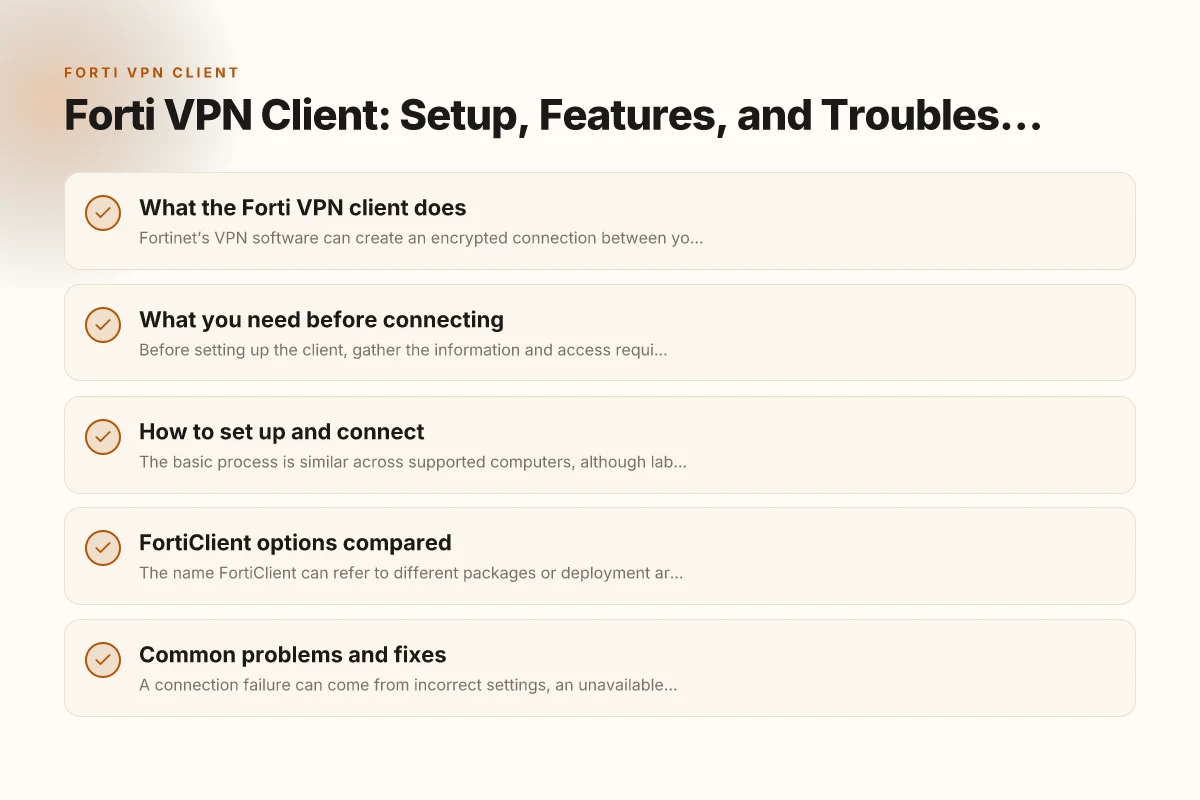
Before setting up the client, gather the information and access required by your organization. This commonly includes: F5 VPN Download: How to Get the Right Client
- The approved FortiClient version for your operating system.
- A VPN address, such as a server name or gateway URL.
- Your company username and password, or another approved sign-in method.
- Multi-factor authentication, if required.
- A connection type or configuration file, if your IT team provides one.
Some organizations use single sign-on, certificates, or managed device settings instead of asking users to enter every detail manually. A company-managed installer or configuration profile may also be required.
Download the software from an official Fortinet source or through your organization’s software portal. Avoid third-party download sites and links in unexpected messages. If your organization provides its own installer, use that version rather than substituting a general-purpose download.
How to set up and connect
The basic process is similar across supported computers, although labels and menus vary by version.
- Install the approved client. Follow the installer prompts and grant only the permissions needed to complete setup. Restart your device if prompted.
- Open the VPN section. Find the option to create or configure a new VPN connection.
- Enter the supplied settings. Add the gateway address and any other details provided by your IT team. Do not guess at connection types or server names.
- Save the profile. Give it a recognizable name, such as your organization’s name, if the client asks for one.
- Connect and authenticate. Select the profile, enter your credentials, and complete any multi-factor authentication prompt.
- Check access. Try the work resource you need. A connected status alone does not guarantee that every application or internal service is available.
If your administrator supplied a configuration file or enrollment link, use it as instructed. Importing an approved configuration can reduce manual entry errors and may apply settings that are not visible in the standard setup flow. Surfshark Is Making My Connection So Slow: How to Fix It
Before you connect: requirements and checks
| Check | What to have or verify | Why it matters | If missing |
|---|---|---|---|
| FortiClient installed | Compatible client version | Enables VPN setup | Install the approved version |
| VPN server address | Hostname or IP address | Identifies the VPN gateway | Ask the administrator |
| VPN type | SSL VPN or IPsec VPN | Determines connection settings | Confirm with the administrator |
| Login credentials | Approved username and authentication | Verifies your access | Request account help |
| Network access | Working internet connection | Provides a route to the gateway | Check local connectivity |
| Organization settings | Required port and connection details | Avoids mismatched configuration | Follow provided instructions |
| Multi-factor authentication | Required second factor | Completes sign-in when enabled | Enroll or contact support |
Compiled November 2026; check the provider's site for current details.
FortiClient options compared
The name FortiClient can refer to different packages or deployment arrangements. The right option depends on your organization’s policies and the features you need.
| Option | Typical use | What to check |
|---|---|---|
| Organization-provided FortiClient | Employees connecting to a company VPN | Version, installation method, and required settings |
| Fortinet download for personal use | Users setting up a supported VPN connection | Whether the available features fit your use and are permitted |
| Centrally managed deployment | Devices administered by an organization | Whether an administrator must configure or unlock settings |
| Mobile app | Connecting from a supported phone or tablet | App availability, device requirements, and company access rules |
Product availability, features, and licensing can change. Check Fortinet’s current documentation and your organization’s instructions for details that apply to your platform and version. Free VPN to Change Location: What to Know Before You Connect
Common problems and fixes
A connection failure can come from incorrect settings, an unavailable network, expired credentials, or an issue on the VPN gateway. Try these basic checks:
- Confirm the gateway address. Compare it with the information from your IT team, including spelling and punctuation.
- Check your internet connection. Open a public website to confirm that your device is online before connecting.
- Review your sign-in. Make sure your password is current and complete any authentication prompt promptly.
- Update the client only as instructed. An incompatible version can prevent a connection, but installing an unapproved version may create additional problems.
- Restart the client and device. This can clear temporary software or network issues.
- Look for a service notice. Your organization may be performing maintenance or restricting VPN access.
If you connect but cannot open a work resource, the problem may be with that resource, your account permissions, or the VPN’s routing rules. Note the error message, the time it occurred, your device and client version, and whether other users are affected. Share those details with IT support rather than changing security settings yourself.
Common VPN problems and what to check
| Problem | First check | Likely next step | Contact support when |
|---|---|---|---|
| Cannot reach VPN gateway | Internet connection and server address | Recheck the gateway details | Address is correct but unreachable |
| Login rejected | Username, password, and account status | Retry approved authentication steps | Credentials still fail |
| Multi-factor prompt fails | Authenticator or verification method | Use the organization’s recovery process | Verification remains unavailable |
| Connection times out | Network access and VPN settings | Try an approved alternative network | Timeout continues |
| Connected, but no access | VPN status and requested resource | Confirm access permissions | Required resources remain blocked |
| Client will not connect | VPN type and connection configuration | Re-enter approved settings | Configuration appears correct |
| Certificate warning appears | Certificate details and system date | Do not bypass the warning; verify it | Certificate cannot be confirmed |
| Connection drops repeatedly | Local network stability | Reconnect and check for client updates | Drops persist across networks |
Compiled November 2026; check the provider's site for current details. Microsoft Edge Menu > Settings > Show Advanced Settings > Change Proxy Settings > LAN Settings
Security and privacy considerations
A VPN protects traffic on the connection according to the organization’s configuration, but it does not make every online activity private or risk-free. Continue to use strong, unique credentials and multi-factor authentication where available.
Keep your operating system and approved VPN client up to date. Do not share configuration files, authentication codes, or VPN credentials. If a device is lost, compromised, or no longer used for work, notify your organization so it can revoke access or remove managed profiles.
Recommendation
Use the FortiClient version and VPN profile provided by your organization, and ask its IT team to confirm the correct settings before connecting. For personal setup, rely on current Fortinet documentation and official download sources, and verify that the VPN service you intend to access supports your chosen client.