FortiClient IPsec over TCP: What It Supports and How to Connect
Learn whether FortiClient supports IPsec over TCP, why it may fail, and which VPN options work through restrictive networks.
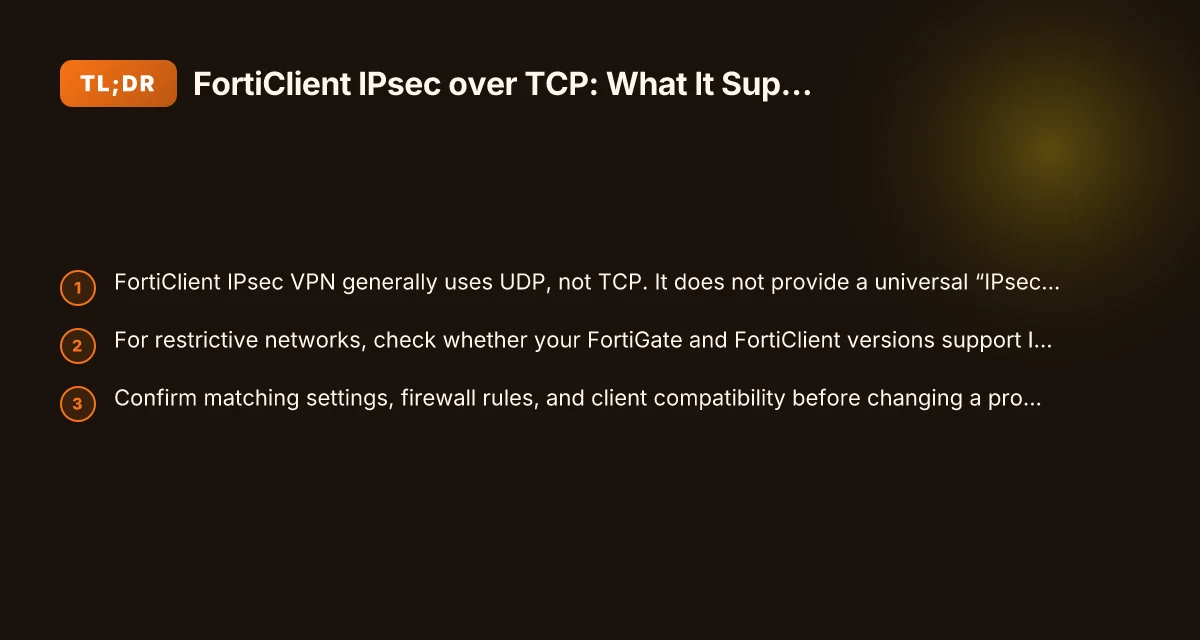
If you are looking for “FortiClient IPsec over TCP,” the key point is that FortiClient IPsec VPN normally uses UDP for IKE and IPsec traffic. It does not automatically turn an IPsec connection into a TCP tunnel just because UDP is blocked. Some FortiGate and FortiClient releases may offer an IPsec-over-TCP option, but support depends on the exact product versions and configuration. Check the documentation for your release before relying on it.

Editor's pick: NordVPN — fast, secure VPN — Strong encryption, a no-logs policy and apps for every device. 30-day money-back guarantee. Get NordVPN →
Compare IPsec over UDP with TCP-based alternatives
| Option | Transport | FortiClient fit | Main advantage | Main limitation |
|---|---|---|---|---|
| IPsec NAT-T | UDP | Standard IPsec option | Works through many NAT devices | May be blocked where UDP is restricted |
| Native IPsec | UDP | Standard IPsec option | Efficient transport | Can have trouble crossing NAT |
| IPsec over TCP | TCP | Not generally supported as a FortiClient IPsec mode | May pass through TCP-only networks | Requires compatible support at both ends |
| SSL VPN | TCP or other configured transport | Separate VPN option | Often works through restrictive networks | Not IPsec |
| OpenVPN | UDP or TCP | Separate VPN client and server | Offers TCP as an option | Requires compatible OpenVPN setup |
| WireGuard | UDP | Separate VPN client and server | Lightweight protocol | No TCP transport mode |
Compiled November 2026; check the provider's site for current details.
Why IPsec usually uses UDP
IPsec commonly uses UDP port 500 for IKE negotiation and UDP port 4500 for NAT traversal. NAT traversal wraps IPsec traffic in UDP so it can cross many routers and firewalls. If a network blocks these ports, the client may fail to establish a tunnel even when the VPN credentials are correct.
This behavior is different from using TCP port 443. A TCP-based VPN can sometimes pass through networks that restrict UDP, but changing the port number alone does not convert IPsec into TCP. The FortiGate and FortiClient must both support and be configured for the same transport method.
Does FortiClient support IPsec over TCP?
There is no single answer that applies to every FortiClient and FortiGate version. Fortinet’s VPN features and configuration options can vary by release, operating system, license, and deployment type. In many standard FortiClient IPsec configurations, the connection uses UDP and the client profile does not include a general-purpose TCP transport setting.
Before troubleshooting, verify: V2Ray for iOS: How to Choose and Set Up a Client
- The FortiClient version and operating system.
- The FortiGate model and FortiOS version.
- Whether the VPN is configured as IPsec or SSL VPN.
- Whether the relevant release documentation explicitly lists IPsec over TCP.
- Whether the feature is available in the client edition and deployment method you use.
Do not assume that an option described for one Fortinet product or release is available in another. If the setting is absent from the supported client interface and documentation, avoid trying undocumented workarounds.
Check these items when troubleshooting a FortiClient IPsec connection
| Check | What to verify | Possible sign of trouble | Next step |
|---|---|---|---|
| VPN type | Profile is IPsec, not SSL VPN | Wrong connection method | Select the intended VPN profile |
| Server settings | Gateway and authentication details match | Login or negotiation failure | Confirm settings with the administrator |
| UDP access | Network permits the required IPsec traffic | Connection works on some networks only | Test another network or ask about firewall rules |
| NAT traversal | NAT-T is configured where needed | Connection fails behind NAT | Check gateway and profile configuration |
| Credentials | Username, password, and certificate are valid | Authentication is rejected | Verify credentials and certificate status |
| Client version | FortiClient version is supported | Unexpected connection behavior | Update or use the approved version |
| Server logs | Gateway records the connection attempt | No attempt or a clear rejection reason | Ask the administrator to review logs |
Compiled November 2026; check the provider's site for current details.
IPsec over UDP compared with TCP-based alternatives
The right solution depends on what the network blocks and what your FortiGate deployment supports. Clash Verge on iPhone: What Works and What to Use Instead
| Connection method | Typical transport | When it may help | Important limitation |
|---|---|---|---|
| FortiClient IPsec VPN | UDP 500 and UDP 4500 when NAT traversal is used | Networks that allow VPN-related UDP traffic | May fail where UDP is blocked |
| IPsec over TCP, if supported | TCP, on a configured port | Environments that permit TCP but restrict UDP | Requires compatible client, gateway, and configuration |
| FortiClient SSL VPN, where available | Commonly TLS over TCP 443 | Networks that allow standard HTTPS traffic | Availability and behavior depend on FortiOS and client versions |
| Another approved remote-access method | Depends on the solution | Organizations with specific network or compliance needs | Must be supported and secured by the administrator |
TCP 443 is often allowed for web traffic, which makes SSL VPN a possible alternative in some environments. However, it is not simply IPsec moved to port 443. It is a different VPN method, and its availability can depend on FortiOS release, licensing, and organizational policy. Fortinet product capabilities change over time, so consult current documentation for your exact versions.
Troubleshooting a FortiClient IPsec connection
If a FortiClient IPsec tunnel will not connect, first determine whether the failure is caused by transport restrictions or by an unrelated configuration issue.
- Check the network path. Ask the network administrator whether outbound UDP 500 and 4500 are permitted. Hotel, guest, corporate, and mobile networks may apply different rules.
- Test from another network. If the VPN works on a mobile hotspot but not on the original network, that points to a firewall or network-policy restriction.
- Confirm the VPN profile. Verify the remote gateway address, authentication method, IKE version, proposals, pre-shared key or certificate, and user credentials.
- Review the FortiGate configuration and logs. The administrator can check whether IKE requests arrive and whether negotiation fails at authentication, proposal matching, or another stage.
- Compare supported versions. Ensure the client and gateway support the intended VPN features and are using compatible settings.
- Try an approved alternative. If UDP is blocked, ask the administrator whether a supported TCP-based option or SSL VPN is available.
Avoid opening broad firewall access or changing VPN settings without authorization. Any adjustment should be limited to the necessary destination and ports, documented, and tested against the organization’s security requirements.
Choose a VPN approach for the network you need to use Clash Verge for iOS: Is It Available, and What Can You Use Instead?
| Network condition | Recommended approach | FortiClient IPsec suitable? | Key consideration |
|---|---|---|---|
| UDP is allowed | IPsec with NAT-T where needed | Yes | Confirm matching gateway settings |
| UDP is blocked | Ask about an approved TCP-capable VPN | Not as IPsec over TCP | TCP support depends on the VPN protocol |
| Network permits only web traffic | Approved SSL VPN, if available | No, it is a different VPN type | Check the organization’s access policy |
| Connection crosses NAT | IPsec with NAT-T | Yes, when configured | Both client and gateway must support it |
| Connection fails on one network | Test another network and check firewall rules | Possibly | A network policy may block VPN traffic |
| Organization requires a specific client | Use the configured, approved profile | Yes, if IPsec is supported | Follow administrator-provided settings |
Compiled November 2026; check the provider's site for current details.
Common misconceptions
“I can set the IPsec port to 443.” A port number does not change the underlying protocol. A gateway and client need a supported method that actually carries the VPN connection over TCP.
“UDP 4500 is always required.” It is commonly used for IPsec NAT traversal, but the precise traffic depends on the path and configuration. A network administrator should confirm what the deployment requires.
“If IPsec fails, my password must be wrong.” Authentication is only one possible failure point. Blocked UDP, mismatched IKE settings, certificates, routing, or firewall rules can also prevent a connection. Sites Blocked When Using VPN: Causes and Fixes
“SSL VPN and IPsec are interchangeable.” Both provide remote access, but they use different protocols and configuration. Moving to one from the other requires a supported profile and gateway setup.
Recommendation
Treat “FortiClient IPsec over TCP” as a version-specific capability, not a universal FortiClient setting. Confirm support in the documentation for your FortiClient and FortiOS releases, then have the VPN administrator validate the gateway configuration and network path. If your environment blocks the UDP traffic used by IPsec and no supported IPsec-over-TCP option is available, use an approved alternative such as SSL VPN where supported rather than attempting an undocumented port change.